How Home Equity Works
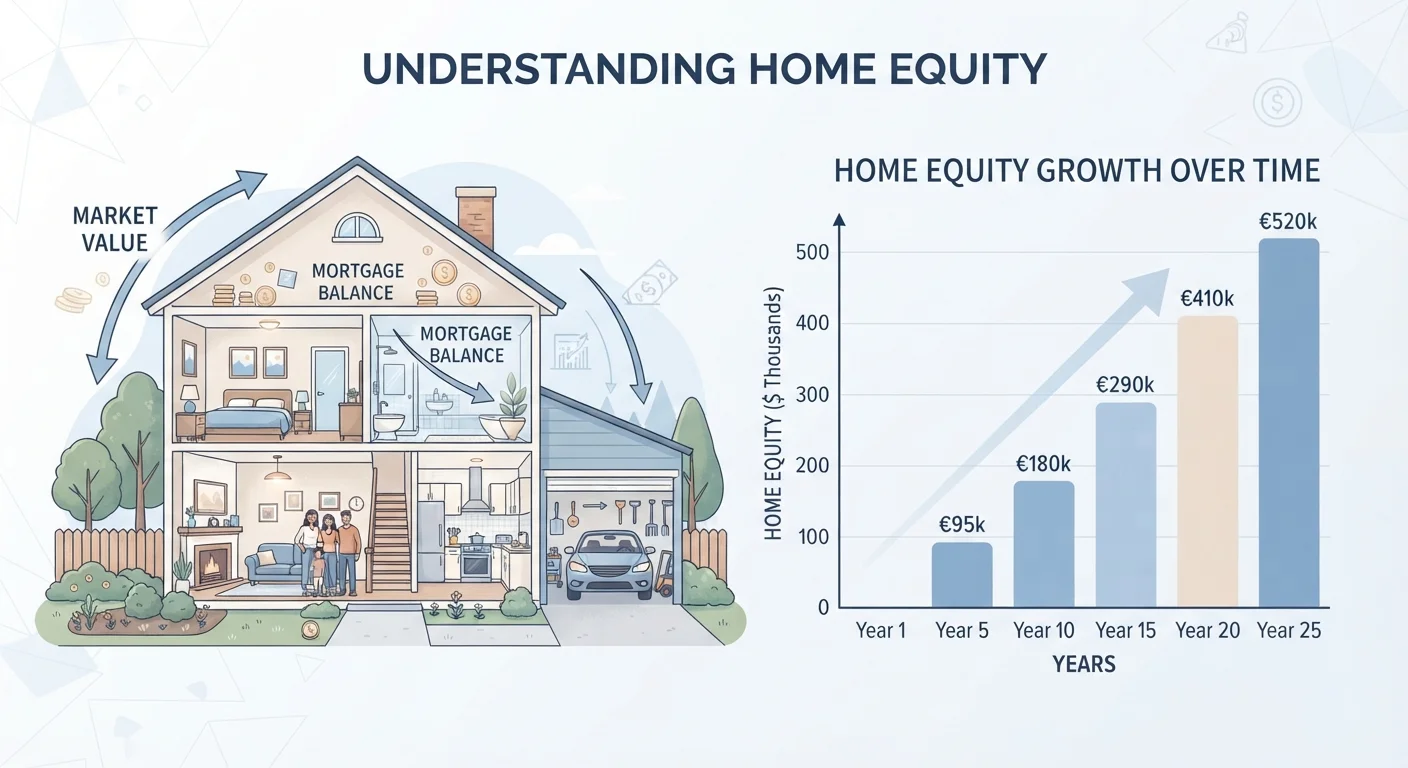
At its core, home equity is a straightforward calculation: take your home's current market value, then subtract the amount you still owe on your mortgage. The difference is your equity. But while the math is simple, the concept has meaningful implications for your long-term financial health.
When you first buy a home, your equity typically equals your down payment. If you put down 10% on a $300,000 home, you start with $30,000 in equity and owe $270,000. From that point, equity grows in two ways: through the principal portion of your monthly mortgage payments, and through any appreciation in your home's market value.
It's worth noting that in the early years of a fixed mortgage, most of your payment goes toward interest rather than principal - a pattern set by how mortgage amortization works. This means equity from principal repayment builds more slowly at first and accelerates later in the loan term. For a deeper look at terminology like amortization and LTV, see our glossary of home buying terms.
~$300,000
Median homeowner equity in the US
According to data from the Federal Reserve's Survey of Consumer Finances, homeowner equity is a primary driver of household net worth for most American families.
3-5%
Typical minimum down payment range
Conventional loans often allow down payments as low as 3-5%, meaning many buyers begin homeownership with relatively limited initial equity.
20%
Equity threshold to avoid PMI
Lenders typically require private mortgage insurance (PMI) until homeowners reach 20% equity, making this a common early milestone for borrowers.
What Builds - and Erodes - Equity
Several factors influence how quickly or slowly your equity grows, and some can work against you.
Factors that build equity
- Mortgage principal payments: Each payment that reduces your loan balance adds to your equity.
- Property value appreciation: If your home increases in market value - due to local demand, neighborhood development, or broader market trends - your equity rises without any additional payment from you.
- Home improvements: Certain renovations may increase your home's appraised value, though not all improvements yield a dollar-for-dollar return.
- Additional principal payments: Paying extra toward your principal each month or year can meaningfully accelerate equity accumulation.
Factors that erode equity
- Market value declines: If local property values fall, your equity shrinks even if your mortgage balance stays the same.
- Borrowing against equity: Taking out a home equity loan or line of credit reduces your equity by adding new debt secured against the home.
- Deferred maintenance: A poorly maintained home may appraise lower than comparables, suppressing its market value.
Consider Extra Principal Payments Early
Because mortgage amortization front-loads interest payments, even modest additional contributions to principal in the early years of a loan can have an outsized effect on how quickly your equity grows. Check with your lender to confirm there are no prepayment penalties before adopting this strategy.
Understanding what affects equity helps homeowners make more informed decisions about renovations, refinancing, and borrowing. For a fuller picture of ownership costs, see the true cost of owning a home beyond the mortgage.
Why Equity Matters in Your Financial Picture
For most American households, the home is their single largest asset. That means home equity often represents a substantial portion of net worth - the total value of everything you own minus everything you owe. As equity grows, so does that asset's contribution to your overall financial standing.
“A home can be both a place to live and a financial asset, but homeowners should understand that equity is a form of illiquid wealth - it only becomes spendable through a sale or by taking on additional debt.”
— Consumer Financial Protection Bureau, US federal agency providing consumer financial education
Equity also creates financial optionality. Homeowners with significant equity may be able to:
- Borrow against it for major expenses through a home equity loan or HELOC (home equity line of credit), though this comes with repayment obligations and risk of foreclosure if payments aren't maintained.
- Use it as a financial cushion when selling - equity becomes cash proceeds after the mortgage is paid off at closing.
- Leverage it when purchasing a subsequent property as part of a move-up or downsizing strategy.
However, equity is not liquid cash. You can't spend it directly without either selling the home or taking on new debt. This distinction matters when thinking about how property fits into a broader financial plan. Explore that relationship further in our article on how property ownership fits into a personal financial plan.
Equity Isn't Always What It Appears
Market valuations of your home are estimates, not guarantees. Your equity figure is only as reliable as the appraisal or comparable sales data it's based on. Formal appraisals - typically conducted during refinancing or sale - provide the most credible snapshot. Some homeowners also hold beliefs about equity that don't always match reality; our article on common myths about homeownership addresses several of these.
This article is for general informational purposes only and does not constitute financial, tax, or legal advice. Consult a qualified financial professional for guidance specific to your situation.