
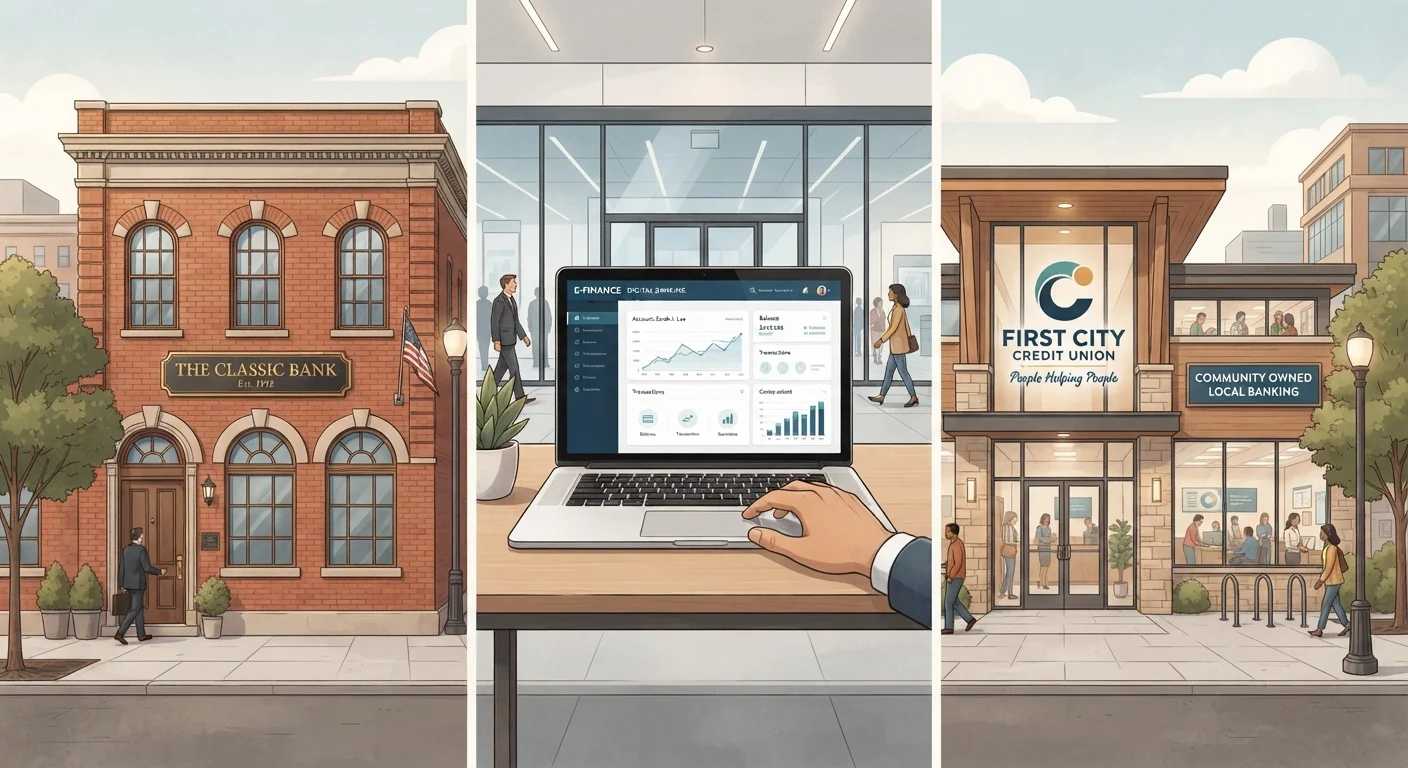
How Each Institution Type Works
Before comparing rates and fees, it helps to understand what makes each institution structurally different - because those differences shape everything from how profits are used to who can open an account.
Traditional banks are for-profit corporations that are owned by shareholders. They earn revenue through interest on loans and fees on accounts, with profits returned to investors. In exchange for that structure, they typically offer the widest range of financial products - from basic checking to mortgages, investment accounts, and business banking - along with extensive branch and ATM networks.
Online banks operate without physical branches, existing entirely through apps and websites. Because they carry significantly lower overhead costs, they can pass savings on to customers in the form of higher annual percentage yields (APYs) on savings accounts and fewer monthly fees. They are still for-profit companies, and deposits are typically FDIC-insured just like at traditional banks. For a deeper look at how this model works, see how online banks handle deposits and support.
Credit unions are member-owned, not-for-profit financial cooperatives. Surplus earnings are returned to members through lower loan rates, higher deposit rates, and reduced fees rather than paid out to outside shareholders. Membership is typically required - often tied to an employer, geographic area, or affiliation - though many credit unions have broadened their eligibility criteria. Deposits are insured by the National Credit Union Administration (NCUA), which provides the same $250,000 per-account coverage as the FDIC. To understand the structural distinction in more detail, see credit unions and banks: understanding the structural difference.
Side-by-Side Comparison
The table below highlights where each institution type typically stands across the criteria that matter most to everyday account holders. Note that individual institutions vary - always verify current terms directly with the institution.
| Traditional Banks | Online Banks | Credit Unions | |
|---|---|---|---|
| Ownership structure | For-profit, shareholder-owned | For-profit, shareholder-owned | Nonprofit, member-owned |
| Deposit insurance | FDIC up to $250,000 | FDIC up to $250,000 | NCUA up to $250,000 |
| Savings interest rates | Generally low on standard accounts | Often among the highest available | Moderate; better than many banks |
| Monthly fees | Common; often waivable | Rare or none | Low to none |
| Branch & ATM access | Extensive networks | ATM reimbursement; no branches | Smaller networks; shared branching |
| Loan rates | Vary widely by product | Competitive on personal loans | Often favorable, especially auto |
| Membership required | No | No | Yes; eligibility criteria apply |
| Cash deposit options | Easy via branches | Limited; varies by institution | Available at branches |
Key Trade-offs to Consider
Knowing the structural differences is just the starting point. Here are the practical trade-offs worth weighing before you decide.
Interest Rates and Fees
Online banks consistently lead on savings APYs because their lower cost base allows it. Traditional banks, particularly large national ones, often pay minimal interest on standard savings accounts and may charge monthly maintenance fees. Credit unions frequently offer rates that sit between the two - better than many traditional banks, though sometimes not as high as the most competitive online banks. Before opening any account, review what to look for in a bank account, including fee structures and minimum balance requirements.
Access and Convenience
Traditional banks hold the advantage in physical access. If you regularly deposit cash, need a notary, or prefer face-to-face help with complex transactions, branch availability matters. Online banks counter this with robust ATM reimbursement programs and 24/7 digital access, but cash deposit options can be limited or inconvenient. Credit unions maintain branches, though their networks are generally smaller - many participate in shared branching networks that expand access significantly.
Loan Products and Rates
Credit unions have historically offered competitive rates on auto loans, personal loans, and mortgages, a direct benefit of their nonprofit structure. Traditional banks offer a wide variety of loan products with varying rates. Online lenders and banks are increasingly competitive on personal loans, but the experience is entirely digital with no in-person underwriting support.
Check the Shared Branching Network
If you're considering a credit union but worry about branch access, look into the CO-OP Shared Branch network. Many credit unions participate, giving members access to thousands of branch locations nationwide. This can significantly reduce the convenience gap compared to large traditional banks.
Customer Service and Trust
Credit unions often score well on member satisfaction surveys, reflecting their community-focused model. Traditional banks offer multiple service channels - phone, branch, and digital - though experiences vary by institution size. Online banks rely on chat, email, and phone support, which can be efficient but may frustrate those who prefer face-to-face resolution.
How to Decide What Fits You
Your banking needs are not static, and many households use more than one institution to meet different goals. For example, a checking account at a traditional bank for everyday transactions combined with a high-yield savings account at an online bank is a common and practical approach. For more on how savings account types compare, see high-yield savings vs. traditional savings accounts.
Ask yourself a few practical questions: Do you deposit cash regularly? Do you want the lowest possible loan rate? Are you comfortable managing everything through an app? Your answers will point you toward the institution type - or combination - that best supports your financial life. And if you share finances with a partner or family member, account access structures matter too; joint accounts carry their own considerations worth reviewing before you sign.
This article is for general informational and educational purposes only and does not constitute personalized financial advice. Consult a qualified financial professional for guidance tailored to your individual circumstances.