
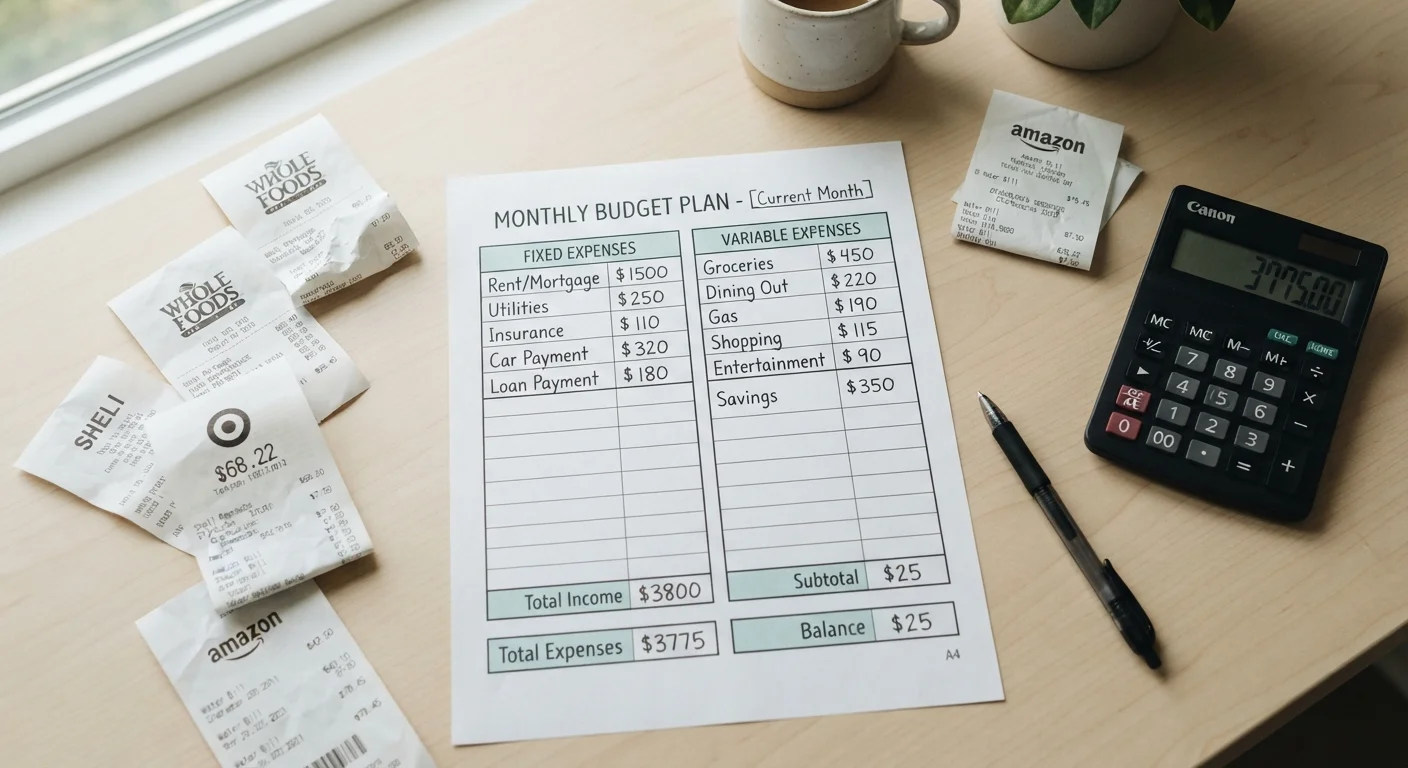
The Core Distinction: Fixed vs. Variable
Every dollar you spend falls into one of two broad categories: fixed or variable. Knowing which is which is the single most practical skill in personal budgeting, because each type requires a different planning approach.
Fixed Expense
A recurring cost that stays the same amount each billing period. Rent, car loans, and insurance premiums are classic examples. Because the amount is predictable, fixed expenses are the easiest to plan for in a budget.
Variable Expense
A cost that changes in amount from month to month depending on usage, behavior, or circumstance. Groceries, gasoline, and utility bills are common variable expenses. These require more active monitoring in a budget.
Discretionary Spending
Money spent on wants rather than needs - dining out, entertainment, hobbies, and subscriptions you could live without. Discretionary spending is typically variable and the most flexible category to adjust when money is tight.
Non-Discretionary Spending
Essential expenses that must be paid to maintain basic living standards, such as rent, utilities, and groceries. These costs are largely unavoidable, though some (like electricity) may still vary in amount.
Irregular Expense
A cost that does not occur every month but recurs periodically - such as annual insurance premiums, car registration fees, or holiday gifts. These are best handled by dividing the annual total by 12 and setting that amount aside monthly.
50/30/20 Rule
A popular budgeting guideline suggesting you allocate roughly 50% of after-tax income to needs, 30% to wants, and 20% to savings or debt repayment. It is a general framework, not a rigid prescription, and individual circumstances will vary.
Fixed expenses are predictable by design. Your rent or mortgage payment, car loan installment, and health insurance premium arrive at the same amount each month. Because you know exactly what is coming, you can slot these numbers directly into your budget without guesswork.
Variable expenses, by contrast, shift with your habits and circumstances. What you spend on groceries, gasoline, restaurants, or electricity depends on choices you make throughout the month. Variable costs give you the most opportunity to adjust your spending - but they also require the most attention.
For a broader introduction to how these categories fit into a complete budget, see our beginner's guide to personal budgeting.
Common Examples in Each Category
Real-life budgets contain a mix of both types. The table below lists typical examples to help you sort your own expenses.
| Fixed Expenses | Variable Expenses |
|---|---|
| Rent or mortgage | Groceries |
| Car loan payment | Gasoline |
| Health insurance premium | Electric and gas utilities |
| Internet service (flat rate) | Dining out |
| Renter's or homeowner's insurance | Entertainment and hobbies |
| Minimum debt payments | Clothing |
Some Expenses Blur the Line
Not every cost fits neatly into fixed or variable. A cell phone plan with a set monthly charge is fixed, but going over your data limit adds a variable overage fee. When a bill has both components, track the base charge as fixed and the overage as variable. This keeps your budget accurate without oversimplifying.
A useful habit: when you review last month's bank statement, mark each line item with an F for fixed or V for variable. Most people find that fixed expenses are fewer in number but larger individually, while variable expenses are more numerous and together add up faster than expected.
| Fixed expense definition | Same amount due each period (e.g., rent, loan payments) |
| Variable expense definition | Amount changes each period (e.g., groceries, gas, utilities) |
| Common fixed expense share of budget | Often 50-60% of monthly take-home pay for many households (General consumer budgeting guidance; individual results vary) |
| Irregular expense planning tip | Divide annual total by 12; save that amount monthly |
| Discretionary vs. non-discretionary | Discretionary = wants; non-discretionary = needs |
| Best tool for tracking variable spending | Rolling 3-month average of past spending by category |
Irregular Expenses: The Third Category Worth Knowing
There is a third spending type that trips up even careful budgeters: irregular expenses. These are costs that do not show up every month but are entirely predictable if you plan ahead - car registration, annual streaming fees, holiday gifts, or a twice-yearly dental visit.
The standard approach is to total your known irregular expenses for the year, divide by 12, and set that amount aside in a dedicated savings bucket each month. When the bill arrives, the money is already waiting.
Our article on spending categories most budgets overlook covers this topic in depth, including a practical worksheet for listing and estimating annual irregular costs.
~33%
Average share of income spent on housing
According to U.S. Bureau of Labor Statistics Consumer Expenditure data, housing consistently represents the largest single expense category for American households.
1 in 3
Americans with no monthly budget
Surveys from the National Foundation for Credit Counseling have found that a significant portion of U.S. adults do not follow a formal budget, making expense categorization especially important.
If you travel regularly, note that trip costs span all three categories - fixed (pre-booked hotels), variable (meals and activities), and irregular (annual travel insurance). See how a travel budget breaks down for a category-by-category look at where travel money actually goes.
For a complete, end-to-end framework that ties all of these categories together, the complete personal budgeting framework walks through every stage from goal-setting to monthly review.
This article is for general informational purposes only and does not constitute personalized financial advice. Consult a licensed financial professional for guidance specific to your situation.