
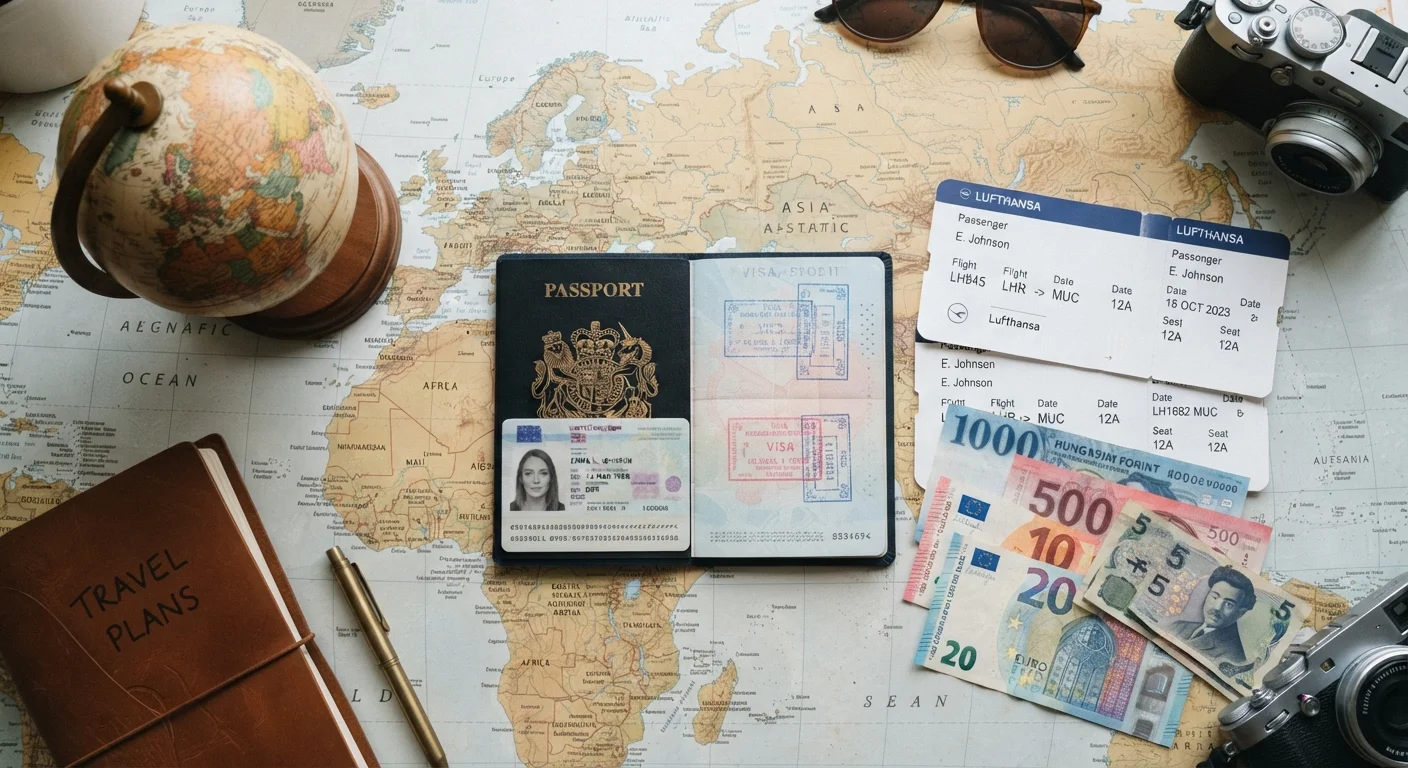
Passports, Visas, and Entry Requirements
Before anything else gets booked, your documentation needs to be in order. For US citizens, a valid US passport is the gateway to international travel. Most countries require your passport to be valid for at least six months beyond your intended departure date - even if your trip is only two weeks long. Check your expiration date early; standard renewal processing can take several weeks, and expedited service is not guaranteed to meet tight timelines.
| Passport validity requirement | At least 6 months beyond your return date (most countries) (US Department of State) |
| Visa-free Schengen stay | Up to 90 days within any 180-day period (European Union entry rules) |
| US travel advisory levels | 4 levels: Normal Precautions to Do Not Travel (US Department of State) |
| Standard passport renewal time | Several weeks (varies; check state.gov for current estimates) (US Department of State) |
| CDC destination health info | Available at cdc.gov/travel for every country (US Centers for Disease Control and Prevention) |
| STEP enrollment | Free Smart Traveler Enrollment Program for US citizens abroad (US Department of State) |
Visa requirements vary dramatically by destination. Many countries - including most of the European Union's Schengen Area, Mexico, and Japan - allow US citizens to enter visa-free for short stays, typically up to 90 days. Others require you to apply for a visa in advance through an embassy or consulate, and some offer a visa on arrival at the port of entry. A handful of destinations require an ETA or similar pre-registration, such as Canada's eTA or Australia's ETA, which you apply for online before traveling.
Always verify entry requirements directly with the destination country's official embassy or consulate website, and cross-reference with the US Department of State's country information pages. Requirements can change, and travel advisories may affect what's possible or advisable. See our pre-trip international preparation checklist for a full walkthrough of visa and documentation steps.
Currency, Money, and Finances Abroad
Understanding how money works at your destination saves real headaches on the road. Most countries have their own currency, and exchange rates fluctuate daily. Rather than exchanging large amounts of cash at airport kiosks - where rates are typically unfavorable - many travelers find that withdrawing local currency from ATMs at their destination offers more competitive rates, though your bank may charge foreign transaction or ATM fees. Notify your bank and credit card issuers before departure to prevent fraud alerts from freezing your cards abroad.
Schengen Area
A group of 27 European countries that have abolished passport controls at their mutual borders, functioning as a single travel zone. US citizens can typically visit Schengen countries visa-free for up to 90 days within any 180-day period.
Electronic Travel Authorization (ETA)
A pre-travel permission linked electronically to a traveler's passport, required by some countries such as Canada and Australia. It is not a visa but must be approved before boarding a flight to the destination.
Foreign Transaction Fee
A surcharge - typically 1-3% - added by some banks or credit card issuers when a purchase is made in a foreign currency or processed through a foreign bank. Cards that waive this fee are common and worth identifying before travel.
Dynamic Currency Conversion
A service offered at some foreign merchants or ATMs that lets you pay in US dollars rather than local currency. The exchange rate applied is usually less favorable than your bank's rate, making it generally better to pay in local currency.
Travel Advisory
An official government warning rating that communicates risk levels for traveling to a particular country or region. The US Department of State issues advisories on a scale from Level 1 (normal precautions) to Level 4 (do not travel).
Visa on Arrival
A visa issued to a traveler upon arriving at a destination's port of entry rather than requiring advance application. Eligibility varies by nationality, and not all travelers or destinations qualify.
Credit cards with no foreign transaction fees are widely accepted in urban areas across Europe, Asia, and the Americas, but cash remains essential in rural regions and smaller local businesses worldwide. Dynamic currency conversion - when a merchant offers to charge you in US dollars instead of local currency - typically results in a worse rate; it's generally better to pay in the local currency.
For a deeper look at how money flows across every part of a trip, the anatomy of a travel budget article breaks down real cost categories from transport to hidden fees.
Health Prep, Travel Insurance, and Safety Advisories
Health preparation varies by region. Some destinations recommend or require proof of specific vaccinations - yellow fever is a common example for parts of Africa and South America. Consult a travel medicine clinician or your primary care provider well in advance of your trip, as some vaccine courses require multiple doses over weeks. The US Centers for Disease Control and Prevention (CDC) maintains destination-specific health notices that are worth reviewing.
Enroll in STEP Before You Go
The US Department of State's Smart Traveler Enrollment Program (STEP) is a free service that registers your trip with the nearest US embassy or consulate. In an emergency - natural disaster, civil unrest, or a personal crisis - enrollment makes it easier for the embassy to locate and assist you. It also delivers destination-specific safety alerts directly to your inbox. Registration takes only a few minutes at travel.state.gov.
Travel insurance is a practical layer of protection that can cover trip cancellation, emergency medical evacuation, and lost luggage - situations where out-of-pocket costs can be significant. Policies vary widely in what they cover, so read the terms carefully before purchasing. Standard US health insurance often provides limited or no coverage outside the country.
For safety context, the US Department of State assigns travel advisories to every country on a four-level scale, from Level 1 (Exercise Normal Precautions) to Level 4 (Do Not Travel). These are updated regularly based on security, health, and natural disaster considerations. Check the advisory level for your destination - and any transit countries - before and shortly before your departure. Pair this with our pre-trip checklist to make sure nothing critical slips through the cracks.
This article provides general travel information for educational purposes only. Entry requirements, health recommendations, and safety conditions change frequently. Always verify current rules with official government sources - including the US Department of State and destination country authorities - before traveling.