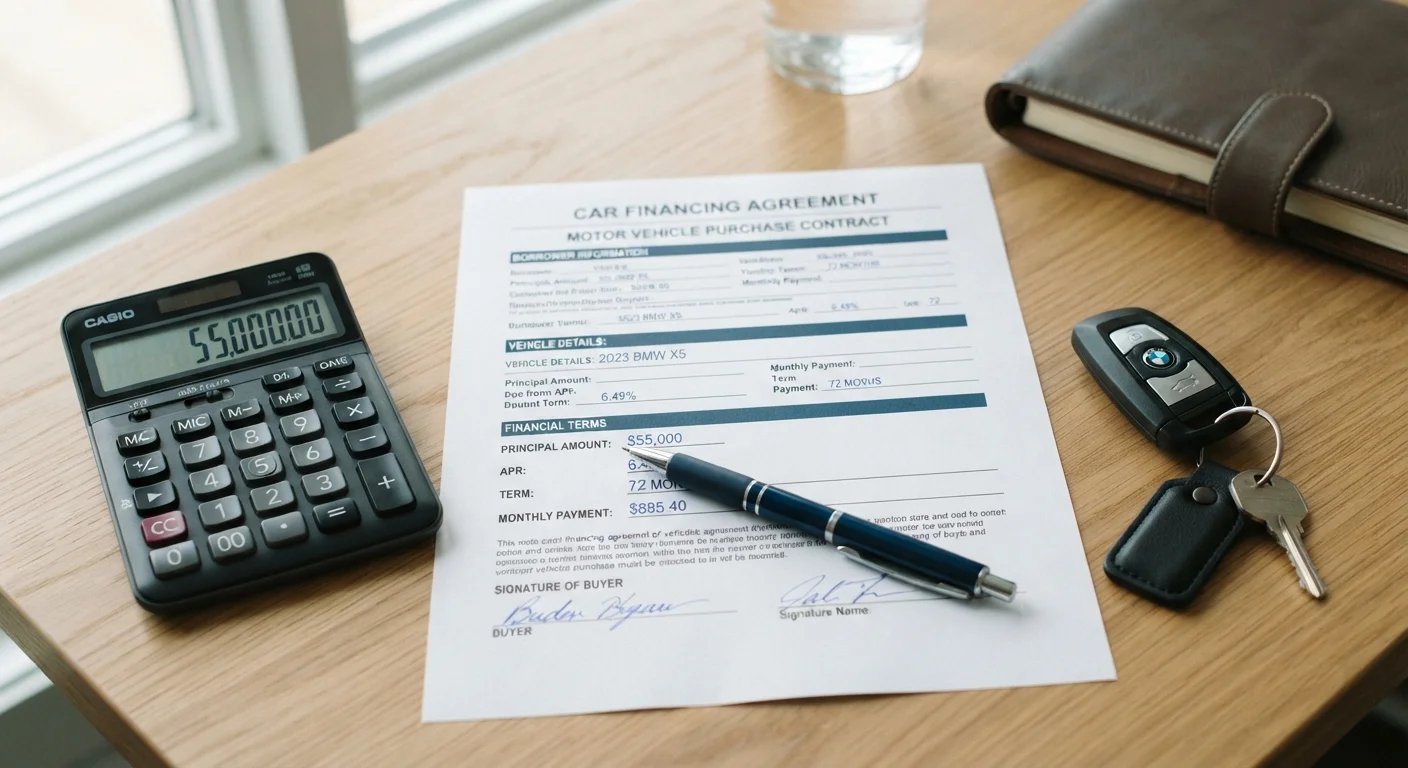

Monthly Payments and Upfront Costs
The most visible difference between leasing and buying is the monthly payment. A lease payment covers the vehicle's depreciation (the loss in value during the lease term) plus a finance charge and taxes - not the full purchase price. This typically makes lease payments 20-30% lower than loan payments on the same vehicle, according to general industry guidance from consumer finance educators.
Buying with a loan means your payments are amortizing the full financed amount. On a $35,000 vehicle with a 60-month loan at a mid-range interest rate, monthly payments can run $600-$700 or more depending on your credit profile and down payment. That said, each payment builds ownership stake.
Upfront costs differ too. Lease agreements often require a security deposit, the first month's payment, and acquisition fees at signing. Purchase transactions typically involve a down payment, dealer fees, registration, and sales tax on the full vehicle price - a considerably larger cash outlay. For a detailed look at how loan terms affect your total cost, see our auto loan terms glossary.
| Criterion | Leasing | Buying |
|---|---|---|
| Monthly Payment | Lower (covers depreciation only) | Higher (amortizes full loan) |
| Upfront Cash Required | Moderate (fees + first payment) | Higher (down payment + tax/fees) |
| Equity Built | None | Yes, grows with each payment |
| Mileage Restrictions | Yes - typically 10K-15K/year | None |
| Insurance Requirements | Higher minimums, gap often required | Standard lender minimums |
| Customization | Not permitted | Unrestricted |
| End-of-Term Options | Return, buy out, or re-lease | Own outright - sell or keep |
| Early Exit Cost | High - fees and penalties | Moderate - sell or trade in |
| Long-Term Total Cost | Higher (continuous payments) | Lower if held past loan payoff |
Insurance, Fuel, and Ongoing Ownership Costs
Insurance is one area where leasing can quietly increase your ongoing expenses. Lenders require comprehensive and collision coverage on financed vehicles, but leasing companies often mandate higher minimum coverage limits than lenders - and some require gap insurance as part of the lease contract. Gap coverage pays the difference between what you owe and the vehicle's actual cash value if it's totaled or stolen. Buyers can opt into gap coverage voluntarily, giving them more flexibility on cost.
Fuel costs are identical regardless of whether you lease or buy - they depend on the vehicle's fuel economy and your driving habits, not ownership structure. For a broader look at how powertrain choice affects running costs, our gas vs. electric ownership cost comparison breaks down those variables.
Maintenance under a lease often falls within the factory warranty window, so major repair bills are rare during the term. However, lease agreements define acceptable wear-and-tear standards - excess wear charges at turn-in for scratches, tire wear, or interior damage can be substantial and are easy to underestimate.
~25%
Typical lease payment discount vs. loan
Consumer finance educators commonly cite lease payments running roughly 20-30% below equivalent loan payments on the same new vehicle.
$0.15-$0.25
Per-mile overage fee range
Industry-standard lease agreements typically charge between $0.15 and $0.25 per mile driven beyond the contracted annual mileage limit.
~50%
Depreciation in first three years
New vehicles commonly lose approximately 40-50% of their original value within the first three years, according to general automotive valuation guidance.
Mileage Limits and End-of-Term Obligations
Most standard lease agreements cap annual mileage at 10,000-15,000 miles. Exceeding that limit triggers a per-mile overage fee - commonly $0.15-$0.25 per mile - which can add hundreds or thousands of dollars to the final bill. Drivers who commute long distances or take frequent road trips should calculate their realistic annual mileage carefully before signing a lease.
At lease end, you return the vehicle with no equity and choose to lease again, purchase the vehicle at a pre-set residual value, or walk away. Walking away is flexible, but it also means starting fresh with new payments. Buyers, by contrast, own the vehicle outright once the loan is satisfied - a meaningful financial milestone that creates months or years of payment-free driving, which materially lowers total cost of ownership over a longer horizon.
Early termination of a lease is also far more expensive than selling a vehicle you own. Breaking a lease typically means paying remaining payments, an early-termination fee, and potential depreciation charges. If lifestyle changes are possible during the term, that inflexibility is a real financial risk. The comparison is not unlike breaking a fixed-term rental lease early, where penalties can significantly outweigh the convenience of exiting.
Total Cost Over Time: The Bigger Picture
Looking at any single lease or loan term in isolation understates the real cost difference. A consumer who leases continuously - cycling from one three-year lease to the next - carries a monthly payment indefinitely and never builds equity. A buyer who finances a vehicle and holds it for eight to ten years pays off the loan, then drives payment-free while the vehicle retains some residual value available at resale or trade-in.
That said, the calculation isn't always straightforward. Depreciation is steepest in the first few years of a vehicle's life, which is precisely when a lease covers it - meaning the lessee avoids that depreciation risk. A buyer who purchases new and sells after three years may also find the equity eroded more than expected.
For budget-conscious drivers exploring their financing options, understanding how dealership and outside financing compare can also shape the total cost equation - our dealer financing vs. outside financing guide explains how each structure works. Separately, readers interested in how analogous rent-or-own dynamics play out in housing may find our look at renting vs. buying a home a useful parallel.
Leasing and Taxes: A Variable Worth Checking
In some U.S. states, sales tax on a leased vehicle is applied only to each monthly payment rather than the full purchase price, which can reduce upfront tax burden compared to buying. However, tax treatment of leases varies significantly by state. Consult your state's department of revenue or a tax professional to understand how this applies in your situation before making a decision based on tax assumptions alone.