
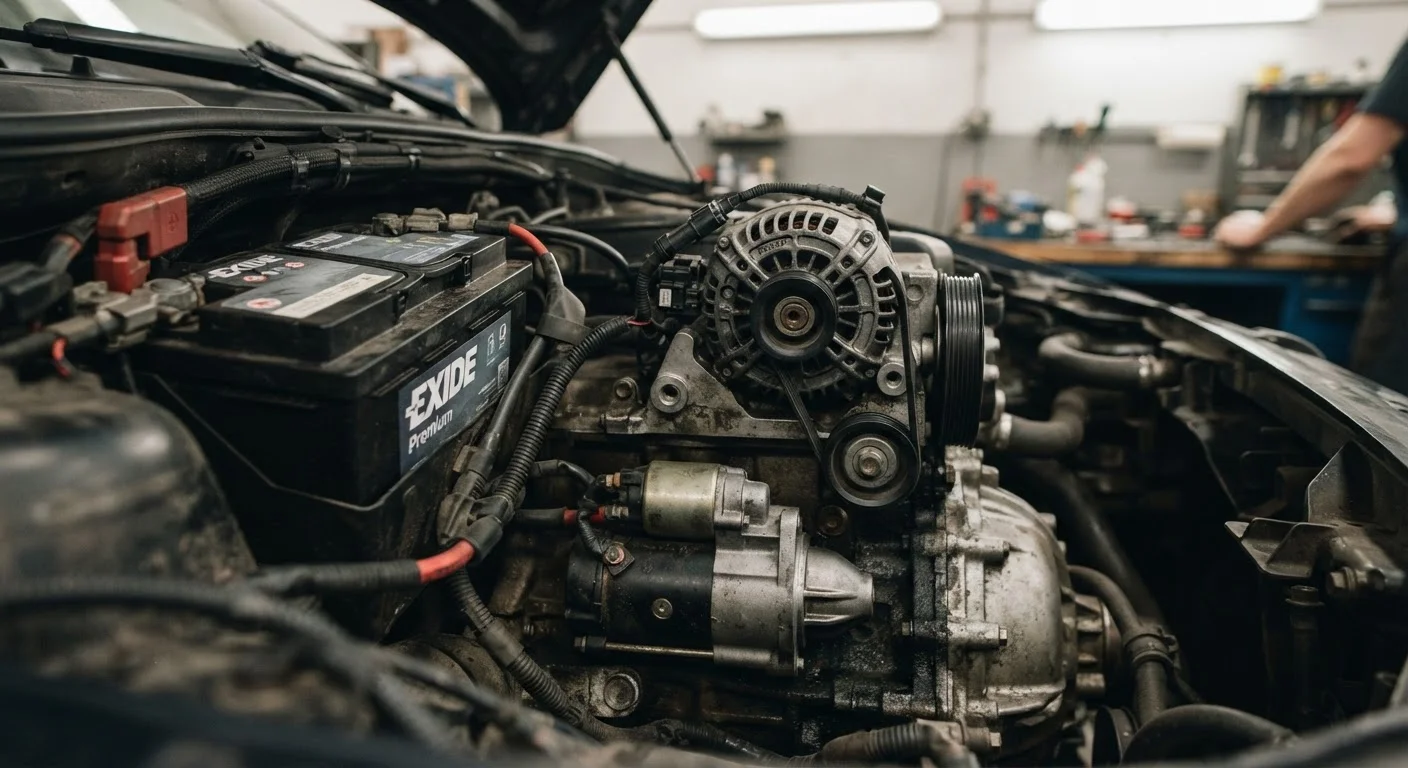
What Each Component Actually Does
Understanding a no-start problem starts with knowing which part does which job - because the three components are often confused with one another.
The battery is the system's energy reserve. It stores a fixed amount of electrical charge and delivers a large burst of it on demand when you turn the ignition. It also powers accessories when the engine is off. Batteries are rated in CCA - the amperage they can deliver at 0°F for 30 seconds - which is why cold weather is so hard on them.
The alternator is a generator driven by the engine's serpentine belt. Once the engine is running, the alternator takes over all electrical duties and simultaneously recharges the battery. A healthy alternator typically outputs between 13.5 and 14.5 volts. Below that range, the battery slowly depletes during every drive.
The starter motor is an electric motor that physically cranks the engine - spinning it fast enough to draw in fuel and air, compress them, and fire. It only operates for a few seconds per start cycle, but it draws a significant amount of current to do so, often 100-200 amps or more.
3-5 years
Typical car battery lifespan
Industry guidance from battery manufacturers and automotive testing organizations consistently cites this range, with heat-prone climates shortening it further.
~40%
Battery capacity loss at 32°F
According to Battery Council International, a fully charged lead-acid battery loses roughly 35-40% of its cranking power at freezing temperatures.
13.5-14.5V
Healthy alternator output range
Automotive service guidelines specify this voltage window as the standard operating range for a functioning charging system at idle and driving speed.
How Failure in One Part Affects the Others
Because these three components form a chain, a fault in one frequently gets misdiagnosed as a fault in another. This is where drivers often spend money unnecessarily.
A failing alternator drains the battery over time. Drivers replace the battery, the car starts again - briefly - and then fails again weeks later because the root cause was never fixed. The same logic applies in reverse: a battery with an internal short can overwork an alternator until it fails from heat stress.
A weak battery can also mimic a starter problem. If the battery cannot deliver adequate amperage, the starter won't engage properly, producing a clicking sound or sluggish crank. Replacing the starter in that scenario won't solve anything.
Test Before You Replace
Before authorizing any part replacement, ask the shop to show you the test results that confirmed the diagnosis. A battery load test, alternator output reading, and starter draw measurement each take only a few minutes and protect you from paying for a part that was not actually faulty. Many independent shops and auto parts retailers offer these tests at no charge.
When diagnosing a no-start, mechanics typically follow a logical sequence: test the battery under load first, then check alternator output, and finally evaluate the starter. Skipping steps leads to parts being replaced unnecessarily. See our overview of commonly skipped maintenance tasks for related repair cost traps to avoid.
Warning Signs Worth Acting On Early
Most electrical failures give advance notice - the problem is that the signals are easy to dismiss or attribute to something else.
- Slow or labored cranking: The engine turns over sluggishly before starting. This is one of the clearest signs of a battery losing capacity.
- Dashboard battery or charging warning light: This light monitors the charging system. If it comes on while driving, the alternator output has dropped below a threshold - do not ignore it.
- Headlights dimming at idle but brightening at higher RPM: The alternator produces more output as engine speed rises; this symptom suggests it is borderline failing.
- Electrical accessories behaving erratically: Windows moving slowly, infotainment screens rebooting, or power seats hesitating all point to voltage instability.
- A battery that keeps needing jump-starts: One jump-start suggests a drained battery. Repeated jump-starts suggest either a parasitic drain, a failing battery, or a charging system problem.
Battery performance also drops sharply in extreme temperatures. Seasonal vehicle preparation should include having the battery tested before winter sets in, not after the first cold-morning failure.
What to Expect From Maintenance and Testing
None of these three components require routine replacement on a fixed schedule the way oil or brake pads do, but each should be tested periodically - particularly the battery.
Many auto parts retailers offer free battery testing using a conductance tester that evaluates remaining capacity without needing to fully discharge the battery first. A load test performed by a mechanic is more comprehensive and can reveal a battery that reads fine on a basic meter but fails under real-world current demands.
Alternator output can be checked with a multimeter while the engine is running. A reading consistently below 13 volts warrants further inspection. Starter draw testing, which measures current consumption during cranking, can confirm whether the motor is working harder than it should.
If your vehicle uses more electrical accessories than average - aftermarket audio, a trailer hitch with lighting, or a car-top refrigerator - factor in the extra load when evaluating alternator health. Drivers considering the long-term cost differences between gasoline and electric vehicles may also want to review the financial tradeoffs between gas and electric ownership, since EV electrical systems operate on fundamentally different principles.
Corrosion Is a Common Hidden Problem
White or blue-green buildup on battery terminals increases electrical resistance and can mimic the symptoms of a failing battery or poor alternator connection. Cleaning terminals with a wire brush and a baking soda solution is a straightforward maintenance step worth doing before concluding a component has failed. If you are uncertain about working near a battery, consult a qualified technician.