
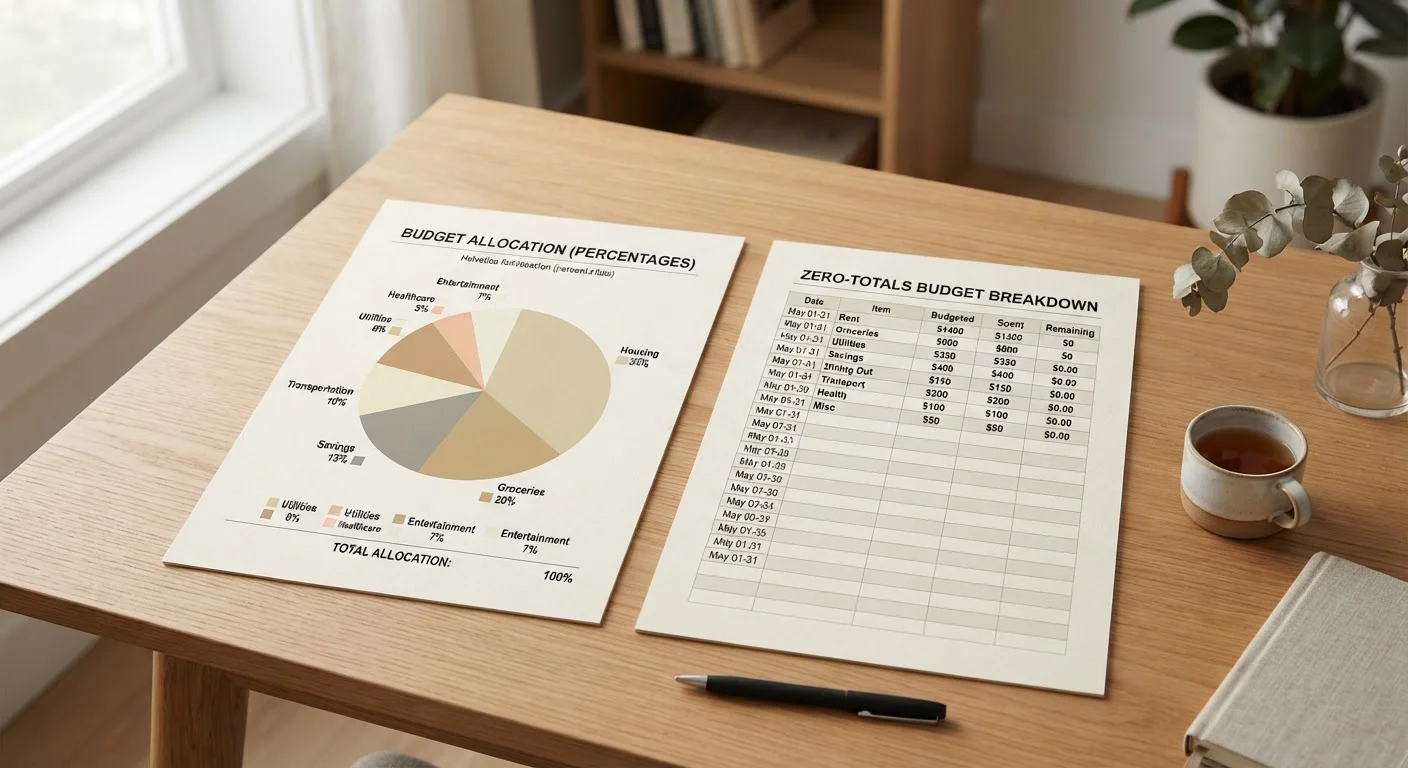
How Each Method Works
Understanding the mechanics of each approach is the first step toward choosing the right one. If you're entirely new to budgeting, our introduction to personal budgeting covers the foundational concepts before you pick a specific framework.
The 50/30/20 Rule
Popularized by Senator Elizabeth Warren and her daughter Amelia Warren Tyagi in their book All Your Worth, the 50/30/20 rule divides your monthly after-tax income into three broad buckets:
- 50% for needs - rent or mortgage, utilities, groceries, insurance, minimum debt payments
- 30% for wants - dining out, subscriptions, hobbies, travel
- 20% for savings and debt repayment - emergency funds, retirement contributions, extra loan payments
The appeal is its simplicity. You calculate three numbers, compare them to your actual spending, and adjust. No spreadsheet with 40 line items required.
Zero-Based Budgeting
Zero-based budgeting (ZBB) operates on a different principle: every dollar of income is deliberately assigned to a category - spending, saving, or giving - until income minus all allocations equals zero. Nothing is left unaccounted for.
Each month begins with a fresh budget built from the ground up. You list anticipated income, then assign amounts to every expense category - groceries, rent, car insurance, clothing, entertainment - until the balance hits zero. The goal isn't to spend everything; it's to make every dollar intentional. Understanding the tradeoffs of strict budgeting can help you weigh whether that level of structure fits your lifestyle before you commit.
| Criterion | 50/30/20 Rule | Zero-Based Budgeting |
|---|---|---|
| Setup time | Low - three categories only | High - every expense itemized |
| Monthly maintenance | Minimal | Rebuilt each month |
| Best income type | Stable, salaried income | Variable or irregular income |
| Spending detail | Broad buckets | Granular line items |
| Flexibility | High within each bucket | Low - each category is fixed |
| Ideal for | Beginners and low-maintenance budgeters | Goal-focused or detail-oriented budgeters |
| Debt payoff focus | Moderate (part of 20% bucket) | Strong (dedicated line item) |
Key Differences in Practice
On paper, both methods point toward the same destination - spending less than you earn and saving consistently. In practice, the day-to-day experience is quite different.
The 50/30/20 rule gives you wide boundaries. If your rent is high one month, it's not necessarily a crisis - as long as your total needs spending stays near 50%, you're on track. This flexibility can feel liberating, but it can also mask slow spending creep. As real-world budgets often reveal, the line between needs and wants is rarely as clean as the framework implies.
Zero-based budgeting eliminates that ambiguity by forcing you to categorize every dollar explicitly. This creates a clearer picture of where money actually goes - but it also demands more time, especially at the start of each month. Missing a category or underestimating a bill can throw off the entire plan, requiring mid-month adjustments.
~75%
Americans without a detailed monthly budget
Gallup polling has consistently found that a majority of U.S. households do not maintain a detailed written budget, underscoring how many people rely on informal or no structure at all.
3-6 months
Recommended emergency fund coverage
Consumer financial guidance from organizations such as the CFPB generally recommends saving enough to cover three to six months of essential expenses.
For people managing irregular income - freelancers, hourly workers, or those with seasonal earnings - zero-based budgeting's monthly rebuild is often more practical than fixed percentages that may not reflect actual take-home pay in a given month.
Which Framework Fits Your Situation?
Neither framework is objectively superior. The right choice depends on your financial goals, your available time, and your personality as a money manager.
The 50/30/20 rule works well as a starting structure - it's forgiving enough to adapt to most income levels and spending styles without overwhelming a new budgeter. It also pairs naturally with automated savings transfers: set up an automatic move of 20% to savings on payday, and the framework largely runs itself.
Zero-based budgeting tends to deliver more traction when a specific goal - eliminating credit card debt, saving for a home down payment, or rebuilding an emergency fund - requires focused, month-by-month allocation decisions. The granularity makes it easier to find and redirect money that would otherwise disappear into vague categories.
It's Okay to Adapt Either Framework
Most budgeting experts acknowledge that rigid adherence to any single method matters less than building a consistent habit of tracking and intentional spending. If the 50/30/20 percentages don't match your cost of living - for example, if housing consumes 40% of your income in a high-cost city - adjusting the ratios is reasonable. Similarly, zero-based budgets can include a small 'miscellaneous' buffer to handle unexpected expenses without derailing the entire plan. The goal is a framework that you'll actually use.
You're also not locked into either method indefinitely. Many people start with the 50/30/20 rule to build the habit of budgeting, then shift to zero-based budgeting when they have a pressing financial goal that demands tighter control. Comparing other methods - including cash envelopes and digital tools - is worth exploring in our guide to envelope budgeting versus digital spending trackers.
Whatever method you choose, the broader principles of building and refining a budget over time are covered in our complete personal budgeting framework. For guidance specific to growing savings alongside your budget, see the Saving & Credit hub.
This article is for general informational and educational purposes only. It does not constitute personalized financial advice. Consider speaking with a qualified financial professional about decisions specific to your situation.