Why the Neighborhood You Choose Defines Your Trip
Ask most travelers what they picture when they think of Paris and the Eiffel Tower appears almost instantly. Understandable - it's extraordinary. But Paris is a city of deeply individual quartiers (neighborhoods), and the arrondissement where you wake up each morning shapes everything: the bakeries you stumble into, the pace of pedestrians around you, the conversations you overhear. What makes European cities feel distinct often comes down to exactly this kind of neighborhood-level texture, and Paris offers it in abundance across 20 arrondissements.
Choosing a base isn't just a logistics decision - it's an editorial choice about the version of Paris you want to experience. The following neighborhoods each tell a different chapter of the city's story.
20
Arrondissements in Paris
Paris's 20 administrative districts each have distinct character, demographics, and architectural heritage, according to the Ville de Paris.
~2.1M
Residents in the city proper
The City of Paris (commune de Paris) population, separate from the broader Île-de-France metropolitan region of over 12 million people.
16
Métro lines serving the city
The Paris Métro network makes most arrondissements easily accessible from a central base, according to RATP, the Paris transit authority.
Le Marais: History, Art, and an Evolving Identity
Spanning parts of the 3rd and 4th arrondissements, Le Marais is one of the few Paris neighborhoods that escaped Baron Haussmann's 19th-century renovation sweeps, leaving intact a remarkable density of medieval and Renaissance architecture. Place des Vosges - the city's oldest planned square - sits at its heart, ringed by symmetrical red-brick arcades that have sheltered residents since 1612.
Today Le Marais layers that history with contemporary galleries, concept stores, Jewish heritage sites along Rue des Rosiers, and one of Europe's most established LGBTQ+ communities. It's a neighborhood that rewards slow walking. Sunday afternoons here feel genuinely festive, when much of Paris has shuttered and Le Marais buzzes. The tension between tourist circuits and local rhythms is at its most interesting in Le Marais, where both worlds genuinely coexist.
Montmartre: The Village on the Hill
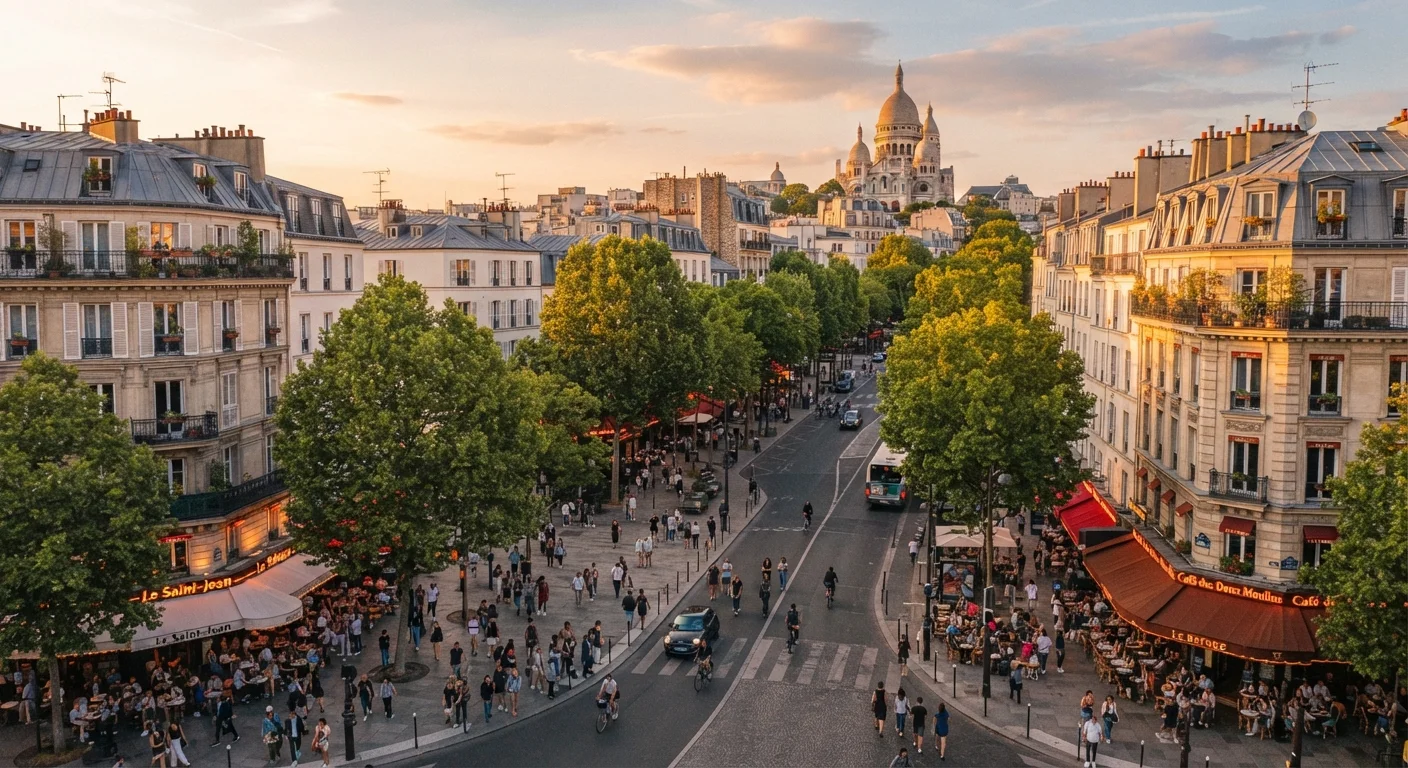
Perched on the city's highest point in the 18th arrondissement, Montmartre earned its romantic reputation honestly. The narrow cobbled streets, steps cascading between terraced houses, and the white domes of Sacré-Cœur basilica create scenery that feels almost impossible in a capital city. In the late 19th and early 20th centuries, artists including Picasso and Toulouse-Lautrec lived and worked here, drawn by cheap rents and creative community.
Present-day Montmartre splits into two distinct experiences. The area immediately around Sacré-Cœur and Place du Tertre is heavily visited and commercially oriented. Walk ten minutes north or west into the residential streets - Rue Lepic, the Lamarck-Caulaincourt steps - and the village atmosphere resurfaces authentically. Montmartre is also within reach of the lively Canal Saint-Martin area, making it a practical base for exploring northern Paris more broadly.
Avoid the Tertre Tourist Trap
Place du Tertre in Montmartre is lined with portrait artists catering almost entirely to visitors - atmospheric, but not the authentic neighborhood experience. Walk five minutes downhill toward Rue Lepic or the Abbesses Métro stop to find the cafés and markets that locals actually use. Early mornings anywhere in Montmartre are noticeably quieter and more rewarding.
Belleville, the 10th, and Paris's Creative East
If the classic postcard image of Paris feels a bit distant from your interests, eastern Paris offers a compelling counterpoint. Belleville (straddling the 19th and 20th arrondissements) is one of the city's most ethnically diverse neighborhoods, with roots in successive waves of immigration that have created layered culinary and cultural scenes. Street art covers significant stretches of its walls, and the neighborhood hosts an open studios weekend each spring that draws visitors from across the city.
The 10th arrondissement - particularly along Canal Saint-Martin - has become a hub for independent cafés, record shops, and design studios without yet feeling self-consciously curated. These neighborhoods make the most sense for travelers curious about how Parisians in their twenties and thirties actually live day-to-day. Maximizing a short European city break often means anchoring in neighborhoods like these, where each block offers something unscripted.
Neighborhoods Change Over Time
Paris neighborhoods are not static - areas that were considered off the beaten path even a decade ago may now be well-established on visitor itineraries. Conversely, some historically famous quarters have become quieter as new creative energy shifts eastward. Checking current travel writing and local blogs before your trip gives you a more accurate picture than guidebooks published several years ago.
How to Choose Where to Base Yourself
No neighborhood is objectively correct - the right choice depends on what you're genuinely after. Travelers prioritizing walkable access to major museums and monuments tend to favor the 1st, 3rd, or 4th arrondissements. Those who want quieter evenings and beautiful classical architecture often look to the 6th or 7th. Visitors drawn to nightlife and independent restaurants increasingly gravitate toward the 10th and 11th.
A few practical considerations worth weighing: Métro proximity matters for comfort on rainy days or late nights. Some neighborhoods that photograph beautifully - upper Montmartre, parts of the 5th - involve sustained uphill walking. And hotel pricing does vary meaningfully by arrondissement, though this should be weighed against commute time to the areas you actually want to explore. Whatever you decide, approach the neighborhoods as destinations in their own right rather than just transit points between monuments. That shift in mindset is often what transforms a good Paris trip into a memorable one.
Travel conditions, entry requirements, and local regulations can change. Always verify current information with official government and tourism sources before booking or traveling.