Why Tire Maintenance Matters
Tires are the only part of your vehicle that actually contacts the road, which makes their condition directly tied to braking performance, fuel efficiency, and how the car handles in wet or emergency situations. Neglecting them isn't just a financial risk - it's a safety one.
The good news is that routine tire care is largely low-cost and manageable at home. Understanding a few fundamentals - pressure, rotation, tread, and alignment - puts most drivers well ahead of common and expensive problems. This guide is part of the broader picture covered in your car's full maintenance schedule, where tire service intervals fit alongside oil changes and other routine checkpoints.
11%
Fuel economy lost to underinflation
The U.S. Department of Energy estimates that underinflated tires can reduce fuel economy by up to 0.2% per PSI below optimal, with cumulative losses reaching 11% in severe cases.
2/32"
Minimum legal tread depth in most U.S. states
Most U.S. states set the legal minimum at 2/32 of an inch, though safety organizations generally recommend replacement consideration starting at 4/32".
5,000-7,500 mi
Typical tire rotation interval
Most vehicle manufacturers recommend tire rotation within this mileage range, though drivers should confirm the interval in their specific owner's manual.
Tire Pressure: The Most Overlooked Weekly Task
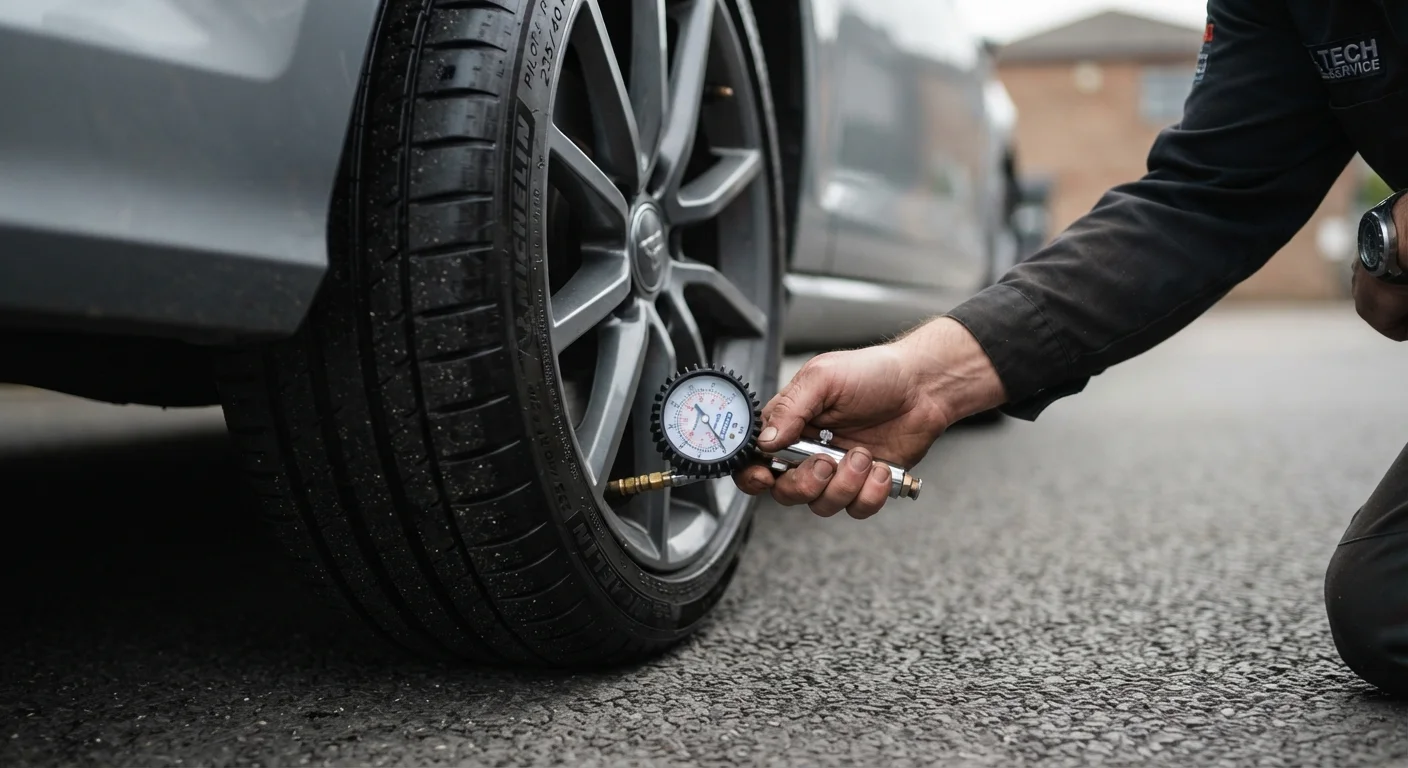
Tire pressure is measured in PSI (pounds per square inch). The correct PSI for your vehicle is listed on a sticker inside the driver's door jamb - not on the tire sidewall, which lists the tire's maximum capacity, not the recommended operating pressure.
Underinflated tires flex excessively, generating heat and increasing rolling resistance. That raises fuel consumption and accelerates shoulder wear. Overinflated tires reduce the contact patch with the road, shortening braking distances and making the ride harsher. Neither extreme serves you well.
Check Pressure When Tires Are Cold
Always check tire pressure before driving or within the first mile of a trip. Heat from driving increases internal air pressure and can make an underinflated tire appear correctly inflated. Checking cold gives you the accurate baseline your vehicle's recommended PSI is based on.
Check pressure when tires are cold - meaning the vehicle has been parked for at least three hours or driven fewer than a mile. Driving heats the air inside tires and raises readings by 4-6 PSI, which can give a false sense of adequacy. A quality analog or digital gauge is inexpensive and more reliable than dashboard TPMS alerts, which typically only activate when pressure drops significantly below the recommended level.
Tire Rotation: When, Why, and How Often
Front and rear tires wear differently depending on whether your vehicle is front-wheel drive, rear-wheel drive, or all-wheel drive, and where the engine load and braking forces concentrate. Rotation moves tires to different positions on the vehicle so wear distributes more evenly across all four.
A general guideline from most vehicle manufacturers is to rotate tires every 5,000 to 7,500 miles, though your owner's manual is the authoritative source for your specific vehicle. Many drivers align rotation with oil change intervals as a convenient reminder.
When having tires rotated, ask the technician to torque the lug nuts to your vehicle's spec with a torque wrench - not just an air gun. Over-torqued lug nuts can warp brake rotors and make future tire changes dangerous.
Lug nut torque is a frequently skipped step at quick-service shops, but improper torque is a leading cause of rotor warping and wheel-related safety incidents.
If you notice your steering wheel pulling to one side after a wheel rotation, don't assume it's an alignment problem right away - ask the shop to swap the front tires side-to-side first. A tire with a manufacturing defect called 'radial pull' can mimic alignment issues.
Radial pull is a known tire defect where internal belt construction causes the tire to drift. Identifying it before paying for an alignment saves money and correctly diagnoses the problem.
Skipping rotation doesn't just shorten tire life - it can void some tire manufacturer warranties. If you drive a vehicle with staggered tire sizes (wider rears than fronts, common on performance vehicles), side-to-side rotation may still be possible even if front-to-rear isn't. A qualified tire technician can advise on the correct pattern for your setup.
Reading Tread Wear and Knowing When to Replace
Tire tread depth is measured in 32nds of an inch. New tires typically start between 10/32" and 11/32". The legal minimum in most U.S. states is 2/32", but most safety experts recommend considering replacement at 4/32" - particularly if you drive in rain regularly.
A quick field check: insert a quarter into a tread groove with Washington's head pointing down. If you can see the top of his head, the tread is at approximately 4/32" - time to plan for replacement. The penny test (Lincoln's head disappearing into the groove indicates 2/32") marks the legal floor, not a safety recommendation.
Uneven Wear Signals an Underlying Problem
Replacing tires without addressing the cause of uneven wear is a costly mistake. If alignment, inflation, or suspension issues aren't corrected first, new tires will wear out following the same pattern. Before purchasing replacement tires, have a technician diagnose the wear pattern and confirm the root cause is resolved.
Pay attention to wear patterns, not just depth. Wear concentrated in the center of the tread suggests chronic overinflation. Wear along both shoulders points to underinflation. Feathering or cupping typically indicates alignment or suspension issues. Uneven wear across one side of the tire is a classic alignment problem. Addressing the root cause before replacing tires prevents the same pattern from repeating on new rubber.
Tire age also matters independently of tread depth. Most manufacturers recommend inspecting tires that are five years old and considering replacement at ten years regardless of visual appearance, because rubber compounds degrade internally over time.
Alignment, Balancing, and Their Role in Tire Life
Wheel alignment refers to the angle at which tires contact the road. When alignment is off - often from hitting a pothole, curb, or running over road debris - tires scrub against the pavement at a slight angle instead of rolling straight. This produces rapid, uneven wear and can pull the vehicle to one side while driving.
Wheel balancing is a separate service. It corrects for small weight imbalances in the tire-and-wheel assembly that cause vibration, typically felt in the steering wheel at highway speeds. Both services require a qualified shop with the appropriate equipment and are not DIY tasks for most drivers.
A reasonable rule of thumb: have alignment checked annually or any time you experience pulling, abnormal vibration, or after a significant road impact. Balancing is often addressed when tires are mounted or rotated. These services protect your tire investment - which connects directly to how driving habits shape what you spend on a car each year.
Don't Skip Alignment After Suspension Work
Any time suspension components - such as control arms, struts, or tie rods - are replaced, alignment must be reset. Skipping this step after suspension repairs leads to rapid and uneven tire wear, often within a few thousand miles. Always request an alignment check as part of any suspension service.
Seasonal and Driving-Habit Considerations
Ambient temperature affects tire pressure. For every 10°F drop in temperature, tire pressure decreases by roughly 1 PSI. That means a tire properly inflated in summer may be noticeably low by mid-winter without a single slow leak. This is one reason cold-weather months generate more TPMS warnings - it's often physics, not a puncture.
If you live in a region with harsh winters, all-season tires have real limitations below freezing, particularly on snow or ice. Winter-specific tires use a different rubber compound that stays pliable in cold temperatures. Refer to seasonal vehicle prep guidance for a broader look at what weather transitions mean for your car overall.
High-mileage drivers, those who frequently carry heavy loads, or drivers on rough road surfaces will see accelerated wear. If your vehicle has crossed six figures on the odometer, maintenance priorities shift, and tire inspection frequency should increase accordingly. Staying ahead of tire wear is one of the more straightforward ways to manage the real ongoing costs of vehicle ownership.
This article is for general informational purposes. Always consult your vehicle's owner's manual and a qualified tire or automotive technician for guidance specific to your vehicle and driving conditions.