How Each Method Actually Works
Understanding the mechanism behind each approach makes it much easier to choose wisely rather than defaulting to what's most familiar or most marketed.
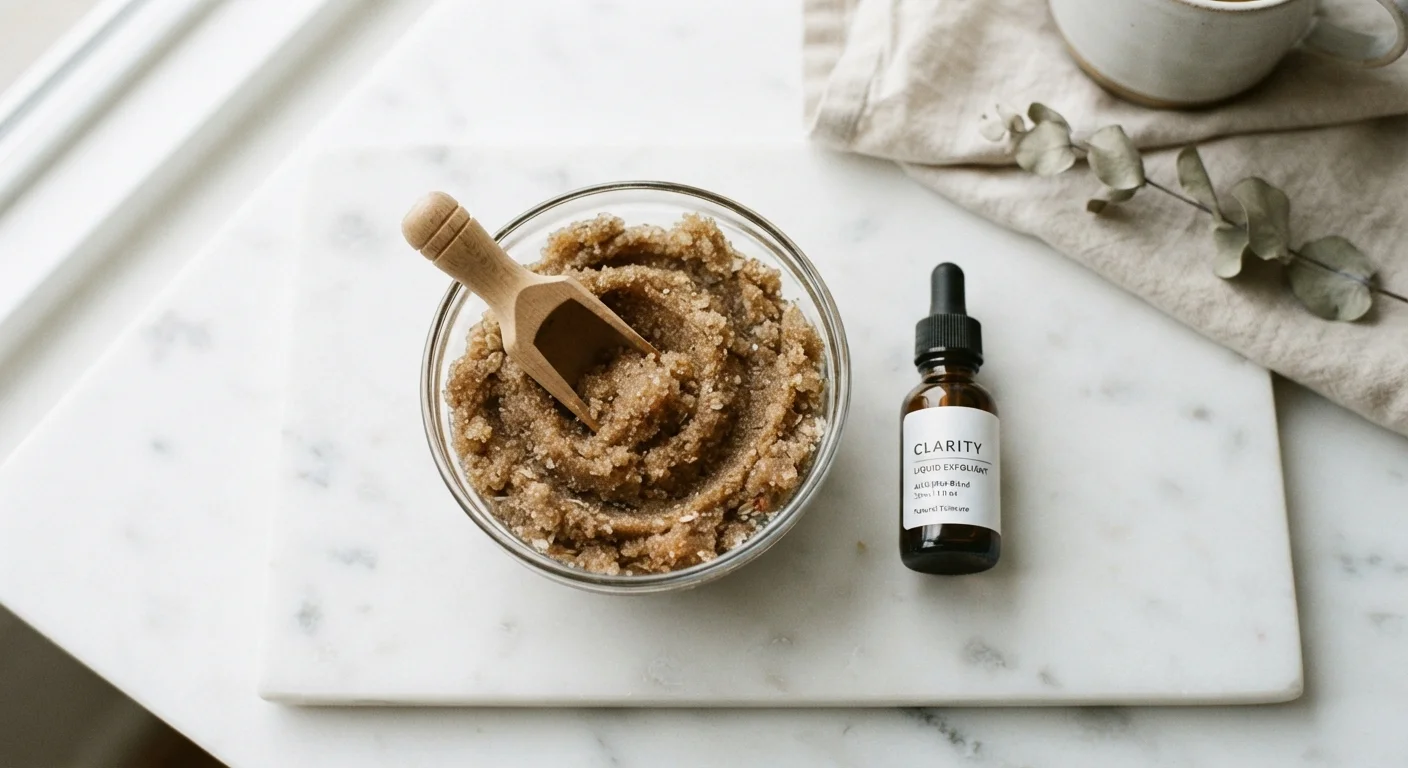
Physical scrubs rely on abrasive particles - sugar, salt, ground seeds, pumice, or synthetic microbeads - to physically dislodge dead cells from the skin's surface through friction. The result is immediate: skin feels smoother the moment you rinse. However, the outcome depends entirely on how coarse the particles are, how much pressure is applied, and the condition of the skin at that moment.
Chemical exfoliants use active ingredients - most commonly alpha-hydroxy acids (AHAs) like glycolic or lactic acid, beta-hydroxy acids (BHAs) like salicylic acid, or enzymes like papain - to loosen the bonds between dead skin cells so they shed more naturally. For a deeper look at how these acid categories differ, see our plain-English guide to exfoliating acids. Results are less immediately dramatic but tend to be more uniform across the skin's surface.
Both methods address the same underlying goal - clearing away the outer layer of dead cells that can make skin look dull or feel rough - but through fundamentally different pathways.
Pros and Cons of Chemical Exfoliants on the Body
Chemical exfoliants have moved well beyond the face. Body lotions and sprays containing AHAs or BHAs are now widely available and designed for use on areas like the arms, back, and legs.
Even coverage across irregular body contours
Acids and enzymes work uniformly across skin regardless of shape, reaching areas like the back of the knees where manual scrubbing is inconsistent.
Effective for keratosis pilaris and rough texture
AHAs are widely used to address the bumpy texture associated with keratosis pilaris, where physical abrasion can actually worsen redness and irritation.
BHAs can penetrate pores on body skin
Salicylic acid, an oil-soluble BHA, can travel into pores to help address body acne - something no physical scrub can achieve.
Results tend to be more consistent over time
Because chemical exfoliants don't rely on pressure or technique, outcomes are less variable from one session to the next.
The primary strength of chemical exfoliants is their ability to work evenly across irregular contours - the backs of arms, knees, and shoulders - without requiring friction that can vary with hand pressure. They're also particularly noted for managing conditions like keratosis pilaris (the small, rough bumps common on upper arms and thighs), where physical scrubbing can worsen inflammation.
Barrier damage from overuse is a real risk
Using chemical exfoliants too frequently - or at too high a concentration - can compromise the skin's moisture barrier, resulting in dryness, sensitivity, or redness.
Increased photosensitivity after use
AHAs in particular can temporarily increase skin's sensitivity to UV radiation, making sun protection more important on treated areas.
Slower visible payoff than physical scrubs
Unlike scrubs, chemical exfoliants don't deliver an immediate tactile change, which can make it harder to gauge whether the product is working in early use.
May not be suitable for all skin conditions
People with eczema, open wounds, or certain skin conditions should avoid acid-based exfoliants without first consulting a healthcare professional.
The main limitation is that chemical exfoliants require attention to concentration and frequency. Overuse - particularly with higher-strength AHA formulas - can compromise the skin barrier, leading to redness, dryness, or increased sensitivity. Always follow label guidance and introduce any new exfoliant gradually.
This article is for general informational purposes only and does not constitute medical or dermatological advice. Consult a qualified healthcare professional for concerns about your skin.
Pros and Cons of Physical Scrubs on the Body
Physical scrubs have been a bathroom staple for decades, and for good reason - they offer immediate sensory satisfaction and are straightforward to use.
~40%
Adults estimated to experience keratosis pilaris
Keratosis pilaris is considered one of the most common benign skin conditions, and chemical exfoliants are among the approaches frequently discussed in dermatology literature for managing it.
2-3x
Typical weekly maximum for body exfoliation
Most dermatology guidance suggests limiting any form of exfoliation to two or three times per week on the body to avoid disrupting the skin barrier.
The main appeal is tactile: most people can feel the difference in texture immediately after use, which makes it easier to stay consistent with a routine. Coarser formulas can also help with rough patches on feet or elbows where the skin is thicker and more tolerant of friction.
Particle Shape Matters in Physical Scrubs
Not all physical scrubs carry the same risk profile. Products with round, uniformly-shaped particles - such as sugar or synthetic spheres - are generally considered gentler than those with irregular, jagged fragments like crushed nut shells. If you prefer physical scrubs, looking for finely-milled formulas with smooth particle shapes is a practical way to reduce friction-related irritation. Regardless of particle type, light pressure is always preferable to vigorous scrubbing.
Where physical scrubs run into trouble is on sensitive or compromised skin. Jagged or irregular particles - like crushed walnut shells - can create microscopic tears that are invisible but may trigger inflammation over time. Finely-milled formulas (round particles, small grain size) are generally considered gentler. Pressure also matters: vigorous scrubbing doesn't equal better results and can damage the skin barrier. For context on how cleansing choices interact with skin health more broadly, see our breakdown of body wash vs. bar soap.
Choosing Based on Skin Type and Body Area
No single exfoliation method works best for everyone or every part of the body. A few practical frameworks help narrow the decision:
- Sensitive or reactive skin: Chemical exfoliants with lower acid concentrations (such as lactic acid, which tends to be gentler than glycolic) are often better tolerated than physical scrubs, which can trigger flare-ups.
- Keratosis pilaris-prone areas: Chemical exfoliants - particularly AHAs - are commonly recommended by dermatologists for smoothing the texture of affected skin on upper arms and thighs. Physical scrubbing alone rarely resolves this condition.
- Rough, calloused areas (heels, elbows): Physical scrubs with a slightly coarser texture may be appropriate here, where skin is naturally thicker and friction is better tolerated.
- Back and shoulders: BHAs like salicylic acid can help manage body acne in these areas since they can penetrate pores, something physical scrubs cannot do.
How you complete your routine after exfoliating also matters. Exfoliation - by either method - temporarily increases skin's sensitivity. Following up with a moisturizer helps restore the barrier, and applying sunscreen to any exposed areas is especially important. For a broader look at how product layering works, see why the order you apply products matters.