What Heat Actually Does to Hair
Hair is composed primarily of a protein called keratin, organized into a layered structure: an outer cuticle of overlapping scales, a cortex of fibrous protein bundles, and in some hair types, a central medulla. When heat is applied, it doesn't simply dry water from the surface - it interacts with these layers in measurable ways.
At moderate temperatures (around 300°F or below), heat temporarily disrupts the hydrogen bonds within the cortex, which is precisely how heat styling works - the hair is reshaped while those bonds are pliable, then reset as it cools. This process is largely reversible with each wash cycle. At higher temperatures (above 360°F), heat can begin to degrade the proteins themselves, alter the hair's moisture content at a structural level, and lift the cuticle scales permanently - causing the dull, rough texture associated with heat damage.
The key variables are temperature, duration of contact, and the hair's baseline condition. Chemically processed, already-porous, or fine hair reaches a damage threshold faster than dense, healthy, unprocessed strands. Understanding this spectrum - rather than treating all heat use as equally harmful - is the foundation for smarter styling decisions.
Myth
All heat styling damages hair equally, so any amount is harmful.
Fact
Heat damage exists on a spectrum determined by temperature, contact time, and hair condition - not all heat use causes the same degree of harm.
Lumping a quick pass with a 300°F flat iron together with repeated high-heat exposure on bleached hair ignores meaningful differences in thermal stress. The cuticle can tolerate moderate heat when it's in good condition. Damage accumulates with extreme temperatures, prolonged contact, and repeated exposure on already-compromised hair - not from occasional, temperature-appropriate styling.
Myth
Letting hair air dry is always safer than using a blow dryer.
Fact
Prolonged exposure to water can actually stress the hair shaft structurally - sometimes more than a properly used dryer on a lower setting.
When hair absorbs water, the cortex swells. Keeping hair in this swollen, wet state for extended periods - as happens with air drying - places repeated osmotic stress on the cuticle and cortex. Research published in dermatology literature has found that hair dried with a blow dryer held at a proper distance and on a moderate setting showed less surface damage than hair left to air dry slowly. The takeaway: technique and tool settings matter more than the binary choice of dryer versus air drying.
Myth
Heat protectants are mostly marketing - they don't actually work.
Fact
Heat protectants have demonstrated measurable protective effects in controlled studies, though they do not make hair invulnerable to heat.
Film-forming ingredients - including dimethicone and other silicone compounds, as well as certain plant-derived polymers - form a temporary barrier on the cuticle that slows heat transfer and reduces friction between the hair and the styling tool. Studies comparing treated and untreated strands at the same temperatures have documented lower rates of surface damage in treated hair. The limitation is real: no protectant eliminates risk at extreme temperatures, and they must be reapplied after each wash to be effective.
Myth
Damaged hair can be repaired with the right products.
Fact
Once the hair shaft's structure is physically damaged, it cannot be biologically repaired - products can improve its appearance and manageability, but not restore the original protein structure.
Hair beyond the scalp is dead tissue. It has no cellular repair mechanism. Products marketed as "repairing" typically work by temporarily filling gaps in the cuticle with conditioning agents, which reduces the look and feel of damage - and that benefit is real and worth having. But this is cosmetic restoration, not structural repair. The only way to eliminate heat-damaged hair is to grow it out. Understanding this distinction helps set realistic expectations and reinforces why prevention is more effective than correction.
Myth
Higher heat settings get the job done faster, so they're more efficient.
Fact
For most hair types, lower heat settings achieve the same style result with significantly less cumulative damage risk.
The assumption that maximum heat means maximum efficiency doesn't hold up. Fine or medium-density hair responds well to temperatures in the 280-330°F range, and forcing those strands through 450°F heat adds stress without a meaningful styling advantage. Even coarse or thick hair - which does benefit from higher temperatures - rarely requires the absolute maximum setting on most tools. Starting lower and adjusting up as needed is a practical approach that preserves hair integrity over time.
Protecting Hair Without Giving Up Heat Styling
The goal isn't to eliminate heat - for many people, that's neither practical nor necessary. The goal is to reduce unnecessary thermal stress on the hair shaft.
Never Flat Iron Wet or Damp Hair
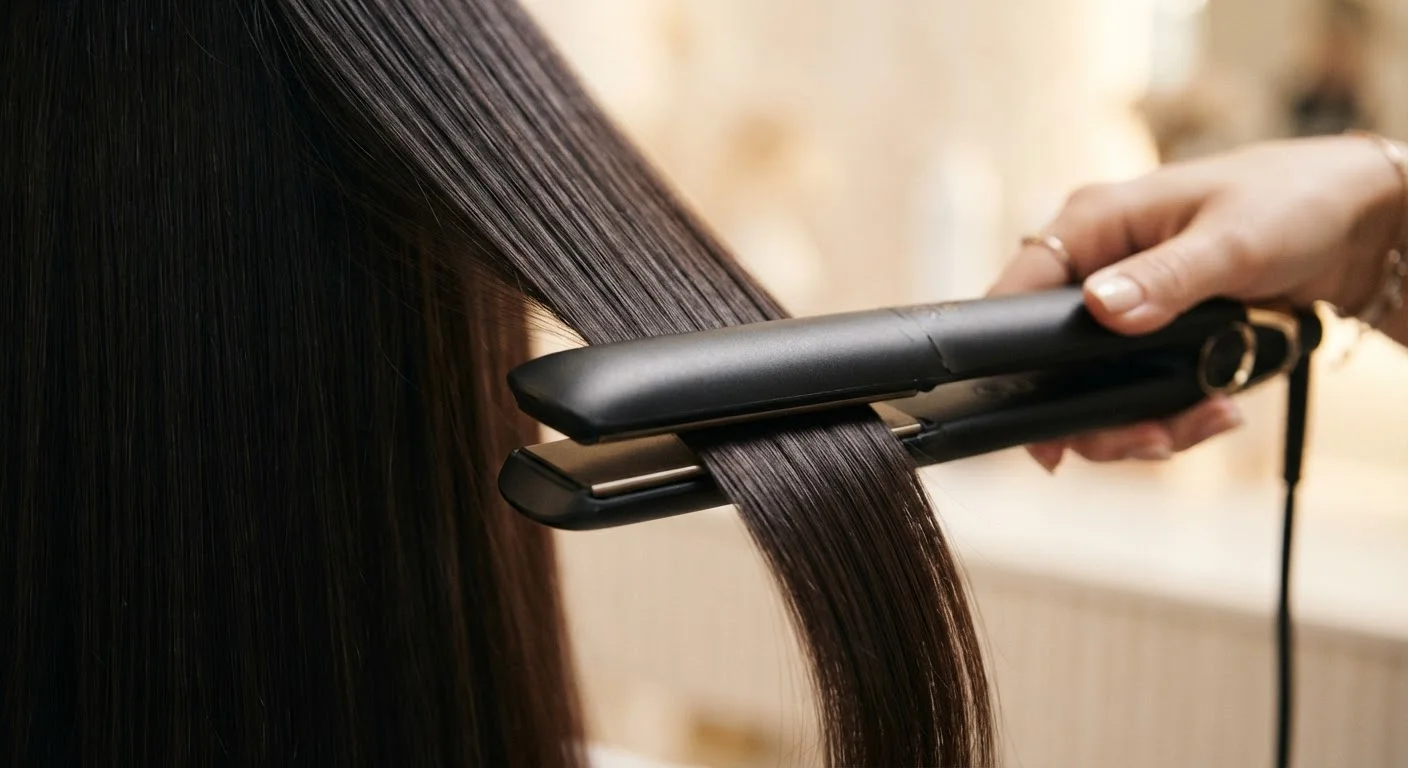
Applying direct flat iron heat to hair that isn't fully dry can cause moisture inside the hair shaft to vaporize instantly. This rapid expansion can fracture the cortex - damage that is structural and irreversible. Always blow dry to completion or allow hair to fully air dry before using a flat iron or curling iron.
Use a heat protectant consistently. These products typically work by coating the cuticle with film-forming agents (such as silicones or certain polymers) that slow heat transfer and reduce friction. They don't make hair heat-proof, but peer-reviewed research does support their ability to reduce surface damage at comparable temperature exposures.
Match your tool's temperature to your hair type. Most styling results can be achieved at 300-350°F for fine to medium hair, and up to 375°F for thick or coarse hair. Many people default to the highest setting out of habit, not necessity.
Ensure hair is fully dry before flat ironing. Styling wet or damp hair with direct heat causes water within the hair shaft to vaporize rapidly - this is sometimes called the "bubble burst" effect - and can fracture the cortex from the inside. A blow dryer on a lower heat setting is a safer first step than jumping straight to a flat iron on damp strands.
For a full picture of how your hair's overall condition affects its resilience, including the role of your scalp, see why scalp health drives hair growth. And if your heat-styling routine is leaving strands feeling dry or brittle, revisiting your conditioning approach may help - what conditioners, deep conditioners, and hair masks each do is worth understanding before reaching for a new tool.
This article is for general informational purposes only and does not constitute medical or dermatological advice. Consult a licensed trichologist or dermatologist for concerns about hair loss or scalp conditions.