City Size, Layout, and Getting Around
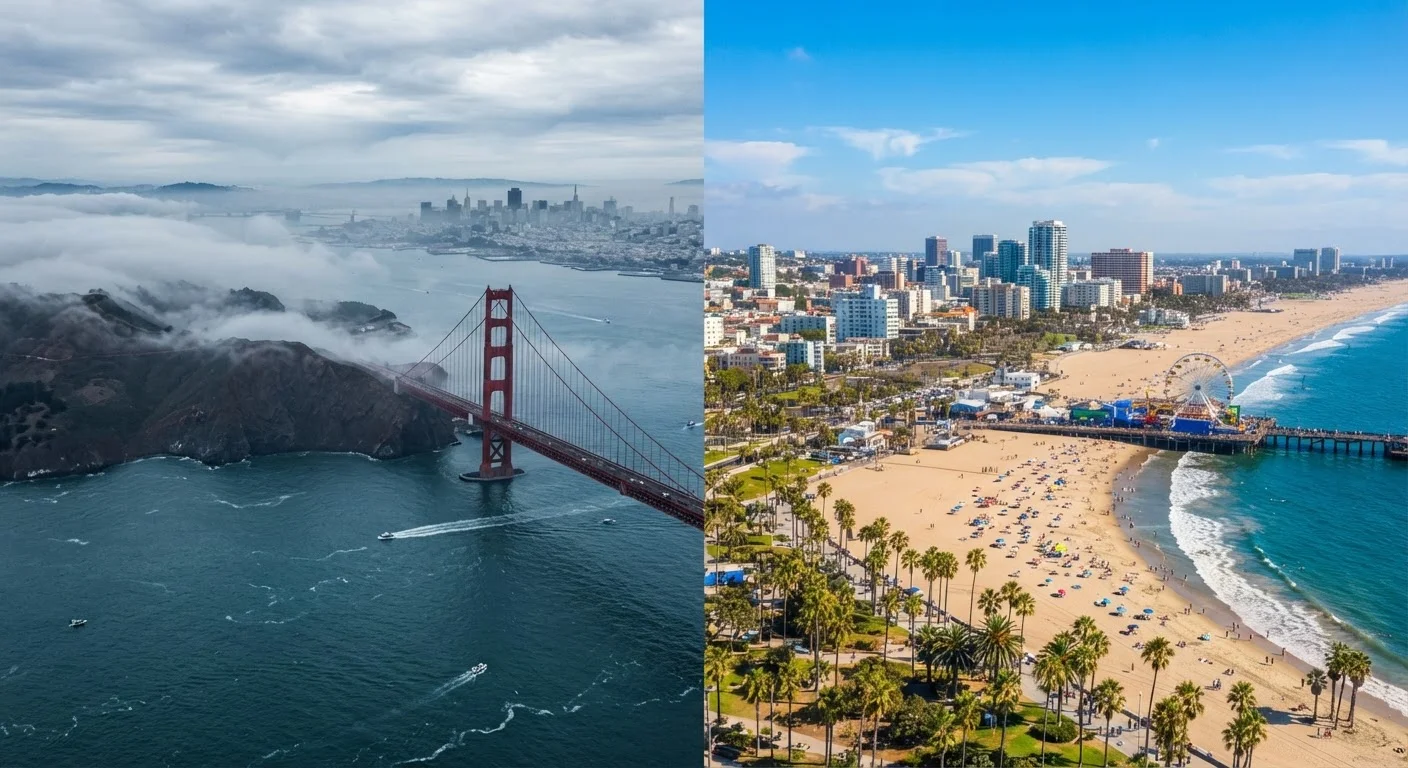
This is where the two cities diverge most sharply. San Francisco covers roughly 47 square miles and is home to around 870,000 residents - dense, hilly, and genuinely navigable without a car. Los Angeles, by contrast, spans over 500 square miles with a metro population exceeding 13 million. It's less a single city than a sprawling collection of communities stitched together by freeways.
In SF, BART (Bay Area Rapid Transit), the Muni streetcar and bus network, and the famous cable cars connect most major neighborhoods. Visitors regularly spend entire trips on foot and public transit. In LA, the Metro Rail system has expanded considerably in recent years, but many neighborhoods - and most of the beach communities - remain inconvenient to reach without a car. Budget for either a rental or significant rideshare costs if you're planning to explore beyond downtown and Hollywood.
For travelers who enjoy the rhythm of walking between neighborhoods and stumbling into local spots, SF's layout is a natural fit. For those who relish the open road and want to cover serious ground, LA's car culture is part of the experience. See how your travel philosophy shapes the right choice in our piece on slow travel vs. packed itineraries.
| Criterion | San Francisco | Los Angeles |
|---|---|---|
| City size | ~47 sq miles | ~500+ sq miles |
| Getting around | Transit & walkable | Primarily car-dependent |
| Typical summer weather | Cool, foggy (55-65°F) | Warm, sunny (80-90°F) |
| Beach swimming | Cold, generally not swimmable | Warm, iconic beach culture |
| Closest nature escape | Muir Woods (~45 min) | Joshua Tree (~2-3 hrs) |
| Food scene identity | Farm-to-table, dim sum, burritos | Tacos, Korean BBQ, celebrity dining |
| Best season to visit | September-November | March-May, September-November |
Climate, Neighborhoods, and Cultural Flavor
San Francisco's weather is famously unpredictable. Summers are often cool and foggy - particularly west of Twin Peaks - while fall (September through November) is widely considered the city's warmest, clearest season. Layers are always advisable. Los Angeles operates on a different solar schedule: warm and dry most of the year, with June Gloom (a coastal overcast pattern) the main seasonal caveat near the shore.
Culturally, both cities are genuinely diverse and endlessly interesting, but they project that diversity differently. SF's neighborhoods are tight-knit and often fiercely local in identity - the Mission's Latino heritage, the Castro's LGBTQ+ history, the Richmond's deep Asian-American community. LA's neighborhoods are similarly rich but spread across a much wider canvas: Koreatown, Little Tokyo, Leimert Park, Silver Lake, and Venice each carry distinct energy that can take days to begin to absorb.
Both cities reward the kind of traveler who wants to go deeper than the postcard version. Our guide to cultural immersion vs. sightseeing explores how to approach either city with real depth.
300+
Days of sunshine per year in Los Angeles
LA's Mediterranean climate makes it one of the sunniest major cities in the US, according to general climatological data.
~47 sq mi
San Francisco's total city area
SF is one of the most densely populated cities in the US, making it unusually walkable for an American metropolis.
8
Distinct SF neighborhoods within 30 min transit
San Francisco's compact layout and transit network mean travelers can visit multiple distinct neighborhoods in a single day.
Day Trips and What Surrounds Each City
The geography surrounding each city is radically different, and that shapes the day-trip menu considerably. From San Francisco, travelers can reach Napa and Sonoma wine country in about an hour, the ancient coastal redwoods of Muir Woods in under 45 minutes, and the dramatic cliffs of Point Reyes National Seashore within 90 minutes. Yosemite Valley is a longer haul - roughly four hours - but entirely doable as an overnight.
From Los Angeles, the directions fan out differently. Joshua Tree National Park sits about two to three hours east and is one of the most otherworldly landscapes in the American Southwest. Santa Barbara is a pleasant 90-minute drive north along the Pacific Coast Highway. Big Bear Lake offers mountain scenery and, in winter, skiing within two hours. Palm Springs, with its mid-century architecture and desert spas, is roughly two hours away.
Neither city's day-trip menu is better - they're just built around completely different landscapes. If you're torn between iconic California and other US destinations that get less attention, our roundup of underappreciated US cities is worth a read before you finalize your plans.
Verify Entry Conditions and Travel Logistics
Prices, transit schedules, park reservation requirements, and seasonal closures can change. Before booking day trips - particularly to national parks like Muir Woods or Joshua Tree, which use timed-entry reservation systems - verify current conditions and requirements through official National Park Service and California state park channels. Costs and availability vary by season.