Why Not All Hair Oils Work the Same Way
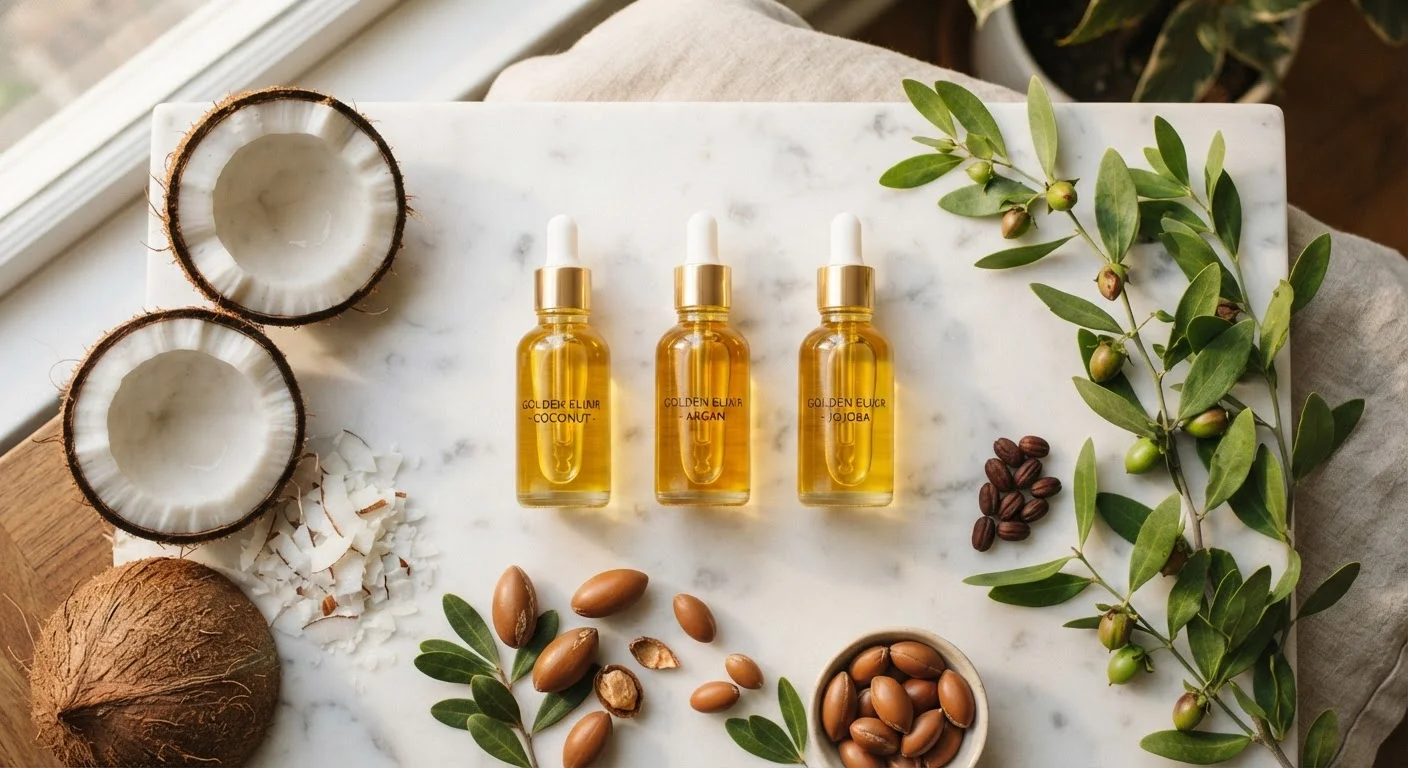
Walk down any beauty aisle and you will find shelves of products featuring coconut, argan, or jojoba oil. But these three oils are not interchangeable - they differ in molecular size, fatty acid composition, and how deeply they interact with the hair strand. Understanding those differences helps you choose an oil that actually addresses your hair's needs rather than one that just sounds appealing on a label.
For context, hair care products list ingredients in descending order of concentration. If you want to understand how to read those lists more critically, our guide on decoding shampoo labels is a useful starting point. And because how well your hair absorbs any oil depends heavily on its porosity, it is also worth reviewing what hair porosity means before committing to a routine.
Coconut Oil: A True Penetrating Oil
Coconut oil is composed primarily of lauric acid, a medium-chain saturated fatty acid with a small, linear molecular structure. This geometry allows it to actually pass through the hair's outer cuticle layer and reach the inner cortex - something most oils cannot do. Research has shown that coconut oil can reduce the amount of protein hair loses during both wet and dry combing, which matters because repeated protein loss contributes to breakage over time.
Because it penetrates rather than simply coats, coconut oil is often used as a pre-wash treatment: applied to dry hair before shampooing to limit swelling of the shaft during wetting. However, this penetrating ability also means it is not ideal for everyone. People with fine or low-porosity hair may find coconut oil sits heavily on strands rather than absorbing, leading to a greasy feel and buildup.
Coconut oil's lauric acid molecules are small enough to penetrate the hair shaft and reduce protein loss.
Argan Oil: A Surface Conditioner and Cuticle Smoother
Argan oil - derived from the kernels of the argan tree native to Morocco - has a very different profile from coconut oil. Its primary fatty acids are oleic acid and linoleic acid, along with a notable concentration of vitamin E (tocopherols) and phenolic compounds. Its larger molecular structure means it does not penetrate the shaft the way coconut oil does; instead, it works primarily on the hair's outer surface.
This makes argan oil effective at smoothing the cuticle layer, reducing frizz, and adding a natural-looking shine. It also provides a degree of thermal protection when applied before heat styling, though it should not be considered a substitute for purpose-formulated heat protectants. Because it is relatively lightweight for a surface oil and absorbs without a heavy residue, it tends to work across a broader range of hair types - including finer textures that coconut oil can overload.
Argan oil works on the hair's surface to smooth the cuticle, reduce frizz, and add visible shine.
Jojoba Oil: Technically a Liquid Wax
Jojoba is unique among the three because it is not technically an oil at all - it is a liquid wax ester derived from the seeds of the jojoba shrub. Its molecular structure closely resembles that of sebum, the natural oil your scalp produces. This similarity means it is generally well-tolerated and less likely to clog follicles than heavier oils.
Jojoba is particularly useful for scalp conditioning. Because it mimics sebum, it can help balance scalp moisture without signaling the skin to produce more or less of its own oil. Applied to the lengths of the hair, jojoba provides a light, non-greasy coating that adds flexibility and reduces brittleness. It is also among the more stable oils in terms of shelf life, as its wax-ester structure resists oxidation better than polyunsaturated oils.
Jojoba's sebum-like structure makes it one of the most scalp-compatible options in natural hair care.
How Hair Porosity Changes Everything
Porosity - the degree to which your hair's cuticle layer allows moisture and other substances to pass in and out - is one of the most important variables in predicting how an oil will perform. Low-porosity hair has tightly packed cuticle scales that resist absorption; heavier oils like coconut oil may not absorb well and can accumulate on the surface. Lighter options like jojoba or diluted argan oil tend to be better tolerated.
High-porosity hair, whether from chemical processing, heat damage, or genetics, has a more open cuticle structure. It tends to absorb oils readily but also loses moisture quickly. For this type, coconut oil's penetrating properties and argan oil's sealing effect can be especially beneficial when used together - coconut as a pre-treatment and argan as a finishing step. Understanding your own porosity level is a practical first step before choosing any oil-based product.
Low-porosity hair resists oil absorption; high-porosity hair absorbs quickly but also loses moisture fast.
How to Apply Each Oil for Best Results
Application method matters as much as oil selection. A few practical guidelines:
- Coconut oil works well as a pre-wash mask on dry hair - apply 20 to 30 minutes before shampooing, focusing on the lengths and ends. Using it on wet hair reduces its penetrating ability.
- Argan oil is versatile enough for post-wash use on towel-dried hair to smooth the cuticle, or applied in small amounts before heat styling. Start with a few drops - it spreads easily.
- Jojoba oil suits both scalp massage (applied directly, left on for 15-20 minutes before washing) and as a lightweight daily serum on ends. Its non-comedogenic profile makes direct scalp contact generally appropriate for most users.
In all cases, less is usually more. Excess oil - regardless of type - can weigh hair down, attract debris, and require extra washing to remove, potentially creating a dryness cycle.
Application timing and quantity matter as much as which oil you choose for your hair type.
Matching the Right Oil to Your Hair
No single oil works universally well for every hair type or concern. Fine, low-porosity hair tends to be weighed down by heavier oils like coconut, while high-porosity or coarser hair often benefits from its deeper penetration. If your scalp is your primary concern - excess oiliness or dryness - jojoba's similarity to your skin's natural sebum makes it worth exploring. For those focused on frizz and surface smoothness, argan oil's cuticle-sealing properties are a logical fit.
Start With a Small Amount and Adjust
When trying any new oil, begin with just two to three drops and assess the result after your hair dries completely. Wet hair can mask heaviness that becomes obvious once dry. Gradually increase the amount only if you find the initial application insufficient - this prevents buildup and makes it easier to identify the ideal quantity for your specific hair volume and texture.
If your hair care routine also includes deep conditioning treatments, understanding how each oil interacts with those products matters. Our breakdown of conditioners, deep conditioners, and hair masks explains how to layer these products effectively. The goal is not to use more products, but to use the right ones in the right order for your specific hair structure.
This article is for general informational and educational purposes only and does not constitute professional medical or dermatological advice. Consult a qualified professional for personalized guidance.