Why the Ingredient List Works the Way It Does
In the United States, the FDA requires cosmetic products - including shampoos - to list ingredients using the International Nomenclature of Cosmetic Ingredients (INCI) system. This is the standardized, globally recognized naming convention that gives every ingredient a consistent scientific name regardless of what the marketing team calls it on the front of the bottle.
The list is organized in descending order of concentration. Whatever appears first makes up the largest portion of the formula by weight. Whatever appears last is present in the smallest amount. This single rule is the most important thing to understand, because it immediately tells you what a product is primarily made of - before you read a single claim on the front label.
There is one important exception: ingredients present at concentrations of 1% or less can be listed in any order after the threshold ingredients. Manufacturers aren't required to disclose the exact cutoff point, so you can't always tell precisely where the 1% line falls. As a general rule of thumb, once you pass roughly the fifth or sixth ingredient on most shampoo labels, you're likely into that lower-concentration zone.
For a useful comparison, the same basic logic governs skincare labels - see our guide to reading a skincare label for a side-by-side look at how the two differ.
What you will need
The Anatomy of a Typical Shampoo Formula
Once you know the ordering rule, you can begin to identify the functional layers of any shampoo formula. Most products follow a recognizable structure:
- Water (Aqua) - Almost universally the first ingredient, serving as the solvent base that carries all other ingredients.
- Surfactants - The cleansing agents that lift oil and debris from hair and scalp. Common examples include Sodium Lauryl Sulfate (SLS), Sodium Laureth Sulfate (SLES), and gentler alternatives like Sodium Cocoyl Isethionate or Cocamidopropyl Betaine. The surfactant type and its position in the list signal the formula's cleansing strength.
- Co-surfactants and conditioning agents - Ingredients like Cocamide DEA or various quaternary ammonium compounds (often called "quats") that soften the cleansing effect and add slip.
- Thickeners and texture modifiers - Sodium Chloride (table salt) or gums like Guar Hydroxypropyltrimonium Chloride adjust viscosity and give the product its characteristic consistency.
- Functional additives - Panthenol (pro-vitamin B5), Niacinamide, or hydrolyzed proteins appear further down, often in the sub-1% range. They contribute targeted benefits but are present in smaller amounts.
- Preservatives and pH adjusters - Ingredients like Phenoxyethanol, Citric Acid, or Sodium Benzoate appear near the end. They keep the formula stable and safe, not cosmetically active.
- Fragrance and colorants - Listed last or near-last; "Fragrance" (or "Parfum") is a legally permitted umbrella term that may represent dozens of undisclosed compounds.
Understanding scalp biology can sharpen how you use this information - our article on why scalp health drives hair growth explains how ingredient choices affect the scalp environment directly.
The 1% Rule Is Your Concentration Guide
Once you've identified roughly where the high-concentration ingredients end and the minor additives begin, you have a realistic picture of what the formula is actually built around. Ingredients present below 1% can have a functional role - preservatives, for example, work effectively at very low concentrations - but a conditioning oil listed 20th is contributing far less than one listed 4th. Context matters as much as presence.
How to Read a Label Step by Step
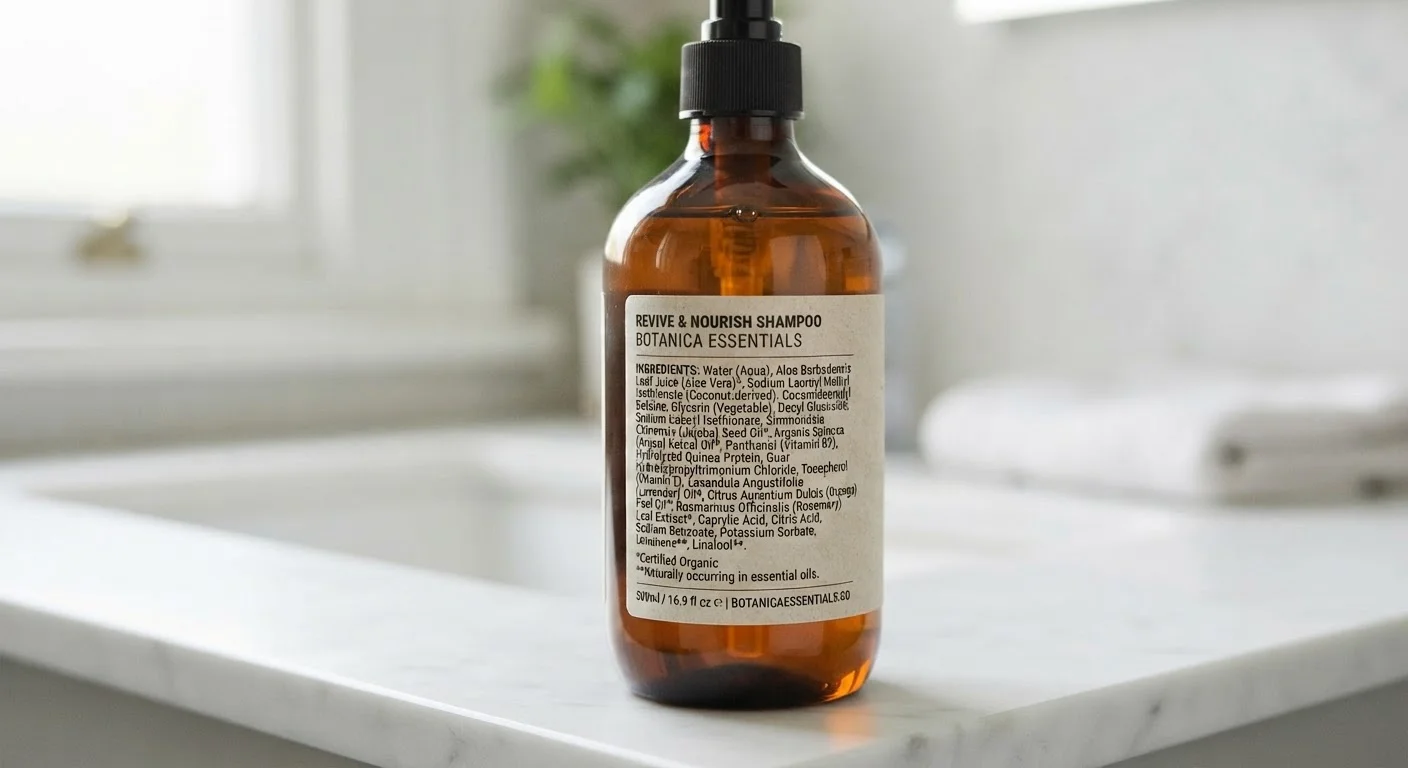
Locate the official ingredient list - not the front label
Flip the bottle to find the panel labeled "Ingredients." This is the regulated section. The claims on the front ("moisturizing," "sulfate-free," "natural") are marketing language and are not subject to the same rules. Always start your analysis from the INCI list, not the product name or front-of-bottle descriptions.
Identify the first five ingredients
These ingredients make up the bulk of the formula by weight. Confirm that water appears first (it almost always does), then identify which surfactant follows. The surfactant's chemical family tells you a great deal about the formula's cleansing intensity. SLS and SLES are effective but more stripping; isethionates and amphoterics like betaines are generally considered gentler on the scalp and hair shaft.
Note the mid-list conditioning and functional ingredients
Scan ingredients in positions six through roughly fifteen. This is where you'll typically find conditioning agents, thickeners, and functional actives like proteins or panthenol. If an ingredient that's being marketed heavily on the front label (say, a specific oil or vitamin) only appears in this range or lower, it is present in a relatively small amount and its contribution will be modest.
Identify preservatives and fragrance near the end
Preservatives keep the formula microbiologically safe - their presence near the end of the list is expected and appropriate, not a red flag on its own. "Fragrance" or "Parfum" appearing here is common; if you have a sensitive scalp or known fragrance sensitivities, this is the entry to watch for. Some labels will itemize individual fragrance components for transparency, while others use the umbrella term.
Cross-reference claims on the front label with what you found
"Sulfate-free" means the formula contains no SLS, SLES, or related sulfate surfactants - you can verify this by confirming the surfactants listed use different chemical families. "Paraben-free" means none of the preservatives end in "-paraben." These are verifiable. Terms like "natural," "clean," or "gentle" have no standardized regulatory definition for cosmetics and cannot be verified from the ingredient list alone.
Once you've worked through the label, you can match what you find to your hair's actual needs. If you're also evaluating conditioners or hair masks, our breakdown of conditioner, deep conditioner, and hair mask explains how those formulas differ. And if natural oils appear in your ingredient list, understanding what each oil actually does helps you evaluate whether they're meaningful additions for your hair type.
Front-Label Claims Are Not Ingredient-List Claims
Terms like "natural," "clean," "gentle," and "dermatologist-tested" carry no standardized legal definition in US cosmetic regulation. They are marketing descriptors, not formulation standards. The only way to assess what's actually in a shampoo is to read the regulated ingredient list on the back or side panel - not the front-of-bottle language.
This article is for general informational and educational purposes only. Ingredient tolerances vary by individual. If you experience scalp irritation or adverse reactions to any hair care product, discontinue use and consult a qualified healthcare or dermatology professional.