Why Small Kitchens Deserve Real Design Attention
Compact kitchens are often treated as purely functional spaces - places to get things done rather than rooms worth styling. But small square footage doesn't mean you have to sacrifice personality. In fact, a smaller canvas can make deliberate design choices feel more impactful.
The key is working with the space's proportions rather than against them. That means selecting decoration strategies that add warmth and character without contributing to the visual noise that makes tight kitchens feel cramped. If you've ever styled your kitchen and still felt something was off, our guide on why kitchens feel cluttered even after decorating can help you pinpoint the problem.
The strategies below are practical, adaptable, and suited to everyday homeowners working with real budgets and real constraints.
Anchor the Space with a Light, Cohesive Color Palette
Color has an outsized effect in small rooms. Light, neutral tones - soft whites, warm creams, pale grays, or muted sage - reflect natural and artificial light, which helps the walls feel farther apart. More importantly, keeping your palette cohesive (meaning your cabinets, walls, and larger accessories share complementary tones) reduces fragmentation. A visually unified space reads as calmer and larger than one with many competing colors.
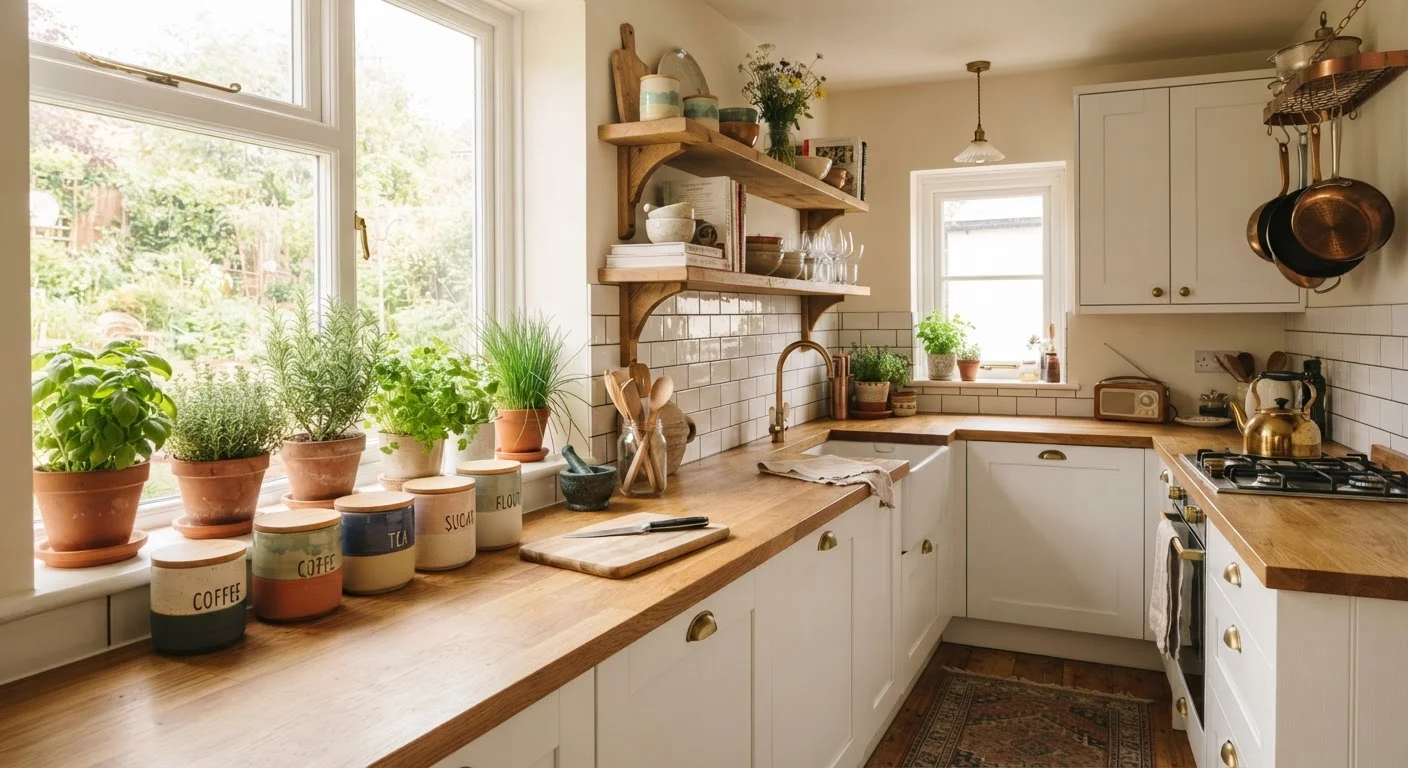
This doesn't mean the space has to be bland. A single pop of color - a cobalt blue vase, a terracotta bowl, a row of warm copper canisters - can add character without overwhelming the eye. The goal is contrast with intention, not contrast everywhere.
A cohesive palette doesn't eliminate personality - it gives personality a clean stage to perform on.
Go Vertical with Wall-Mounted Storage and Display
Counter space is a premium in small kitchens, so the walls become your best decorating surface. Wall-mounted shelves, pegboards, magnetic knife strips, and hanging pot racks lift functional items off the countertop while adding a layered, styled look to bare walls.
Open shelving deserves special mention here: when styled thoughtfully, it turns everyday items - stacked plates, glass jars of dry goods, a row of cookbooks - into decoration. That said, open shelves require consistent editing to avoid becoming a clutter magnet. Our article on open shelving trade-offs walks through the real-world considerations before you commit.
Walls are the most underused decorating surface in any small kitchen.
Use Lighting as a Decorative and Functional Tool
Overhead lighting alone tends to flatten small spaces. Layering light sources - under-cabinet LED strips, a pendant over an island or peninsula, a plug-in sconce near a prep area - adds depth and warmth while making the kitchen feel more intentionally designed.
A well-chosen pendant light or fixture can also serve as the room's visual anchor, the equivalent of a piece of statement art. It draws the eye upward, which subtly adds to the perceived height of the space. When selecting fixtures, scale matters: one appropriately sized statement piece often reads better than several small ones competing for attention.
Layered lighting adds depth and makes a small kitchen feel more intentionally designed.
Let Functional Items Pull Double Duty as Décor
In a small kitchen, every surface counts - so the items that live on your counter should earn their place both functionally and visually. Matching ceramic canisters, a wooden bread box, a set of coordinated cutting boards stood upright on the counter, or a well-styled fruit bowl all add warmth without requiring dedicated display space.
Cookware itself can be decorative when hung or displayed intentionally. A row of cast iron pans or a set of colorful enamel pots on open hooks contributes to the kitchen's personality while keeping them accessible. The principle is simple: when something must be out in the open, make sure it contributes to the overall look.
When counter space is limited, every item should be both useful and visually intentional.
Introduce Greenery at the Right Scale
Plants bring life, texture, and color into a kitchen without demanding much floor space. A small pot of fresh herbs on a windowsill, a trailing pothos on an upper shelf, or a compact succulent tucked beside the backsplash all add organic warmth that hard materials can't replicate.
Scale is the critical factor. In a small kitchen, oversized plants compete with the architecture; smaller varieties or a tight cluster of like-sized pots tends to work better. For guidance on which plants handle kitchen conditions well, see our article on plants that thrive in kitchens. For broader design principles around greenery placement, indoor plants as décor covers scale, grouping, and visual role.
Compact greenery adds organic warmth that no hard surface or accessory can fully replicate.
Add One Bold Accent to Anchor the Room's Personality
Small kitchens benefit from having a single strong visual statement rather than several competing ones. This might be a patterned tile backsplash, a colorful runner rug, an oversized piece of framed art on an empty wall, or a dramatically different cabinet color on a lower island. One well-chosen accent creates a focal point and gives the entire room a sense of design intention.
The surrounding elements should support - not rival - that anchor piece. If the backsplash is the star, keep countertop accessories quieter. If the rug carries the color story, let the walls and cabinets remain neutral. For more on applying this principle across compact spaces, small-space decorating strategies offers additional room-by-room approaches.
One deliberate bold accent gives a small kitchen a point of view without overwhelming it.
Putting It All Together
Great small-kitchen decoration isn't about filling every surface - it's about making intentional choices that reinforce a cohesive look. Start with one or two strategies that feel most achievable, then build from there. For renters who want personality without permanent changes, decorating a rental kitchen without permanent changes offers a useful starting point.
Edit Before You Add
Before introducing any new decorative element, remove something first. In small kitchens, addition without subtraction almost always tips the balance toward clutter. A disciplined editing habit keeps the space feeling curated rather than crowded.
For broader spatial ideas beyond decoration alone, explore smart spatial strategies for small kitchens and the Home Décor Tips hub for room-by-room inspiration.