Why Decorating Sometimes Makes Things Worse
You cleared the counters, added a few decorative touches, and rearranged the display shelves - yet the kitchen still feels busy and unsettled. This is one of the most common frustrations homeowners describe, and it usually comes down to a handful of specific, fixable missteps rather than the space itself.
A cluttered feeling isn't always about the amount of stuff in a room. It's often about how that stuff is arranged, how colors and finishes relate to each other, and whether storage is doing its proper job. If you're starting fresh, running through a pre-decoration checklist before adding anything new can help you avoid the most costly missteps. For first-time homeowners, understanding foundational decoration decisions is an equally useful place to start.
Decoration Alone Won't Fix Storage Problems
If your kitchen lacks adequate storage, adding decorative pieces will make the space feel worse, not better. Before decorating, assess whether your layout and storage meet basic functional needs. Addressing storage gaps first gives any décor choices a much stronger foundation.
The Most Common Mistakes - and How to Correct Them
The mistakes below apply to kitchens of all sizes, though their impact tends to be sharper in compact spaces. If your kitchen is on the smaller side, the principles here pair well with decoration strategies built specifically for compact kitchens.
Filling every surface with decorative objects at the same height.
Why it happens: When homeowners decorate, it's tempting to display everything they love at once. Items land wherever there's room, creating a flat, uniform layer of objects that the eye can't navigate.
Keeping countertop appliances out permanently even when rarely used.
Why it happens: Appliances feel important, so homeowners assume they belong on the counter. Over time, several rarely-used machines accumulate and take over valuable surface area.
Mixing too many colors, finishes, and textures without a unifying thread.
Why it happens: Décor is often bought piece by piece over time, so items are chosen for individual appeal rather than how they work together in the space.
Neglecting vertical storage and wall space in favor of horizontal surfaces.
Why it happens: Countertops and shelves are the most obvious places to put things, so they receive the most attention. Walls and the space above eye level are often overlooked.
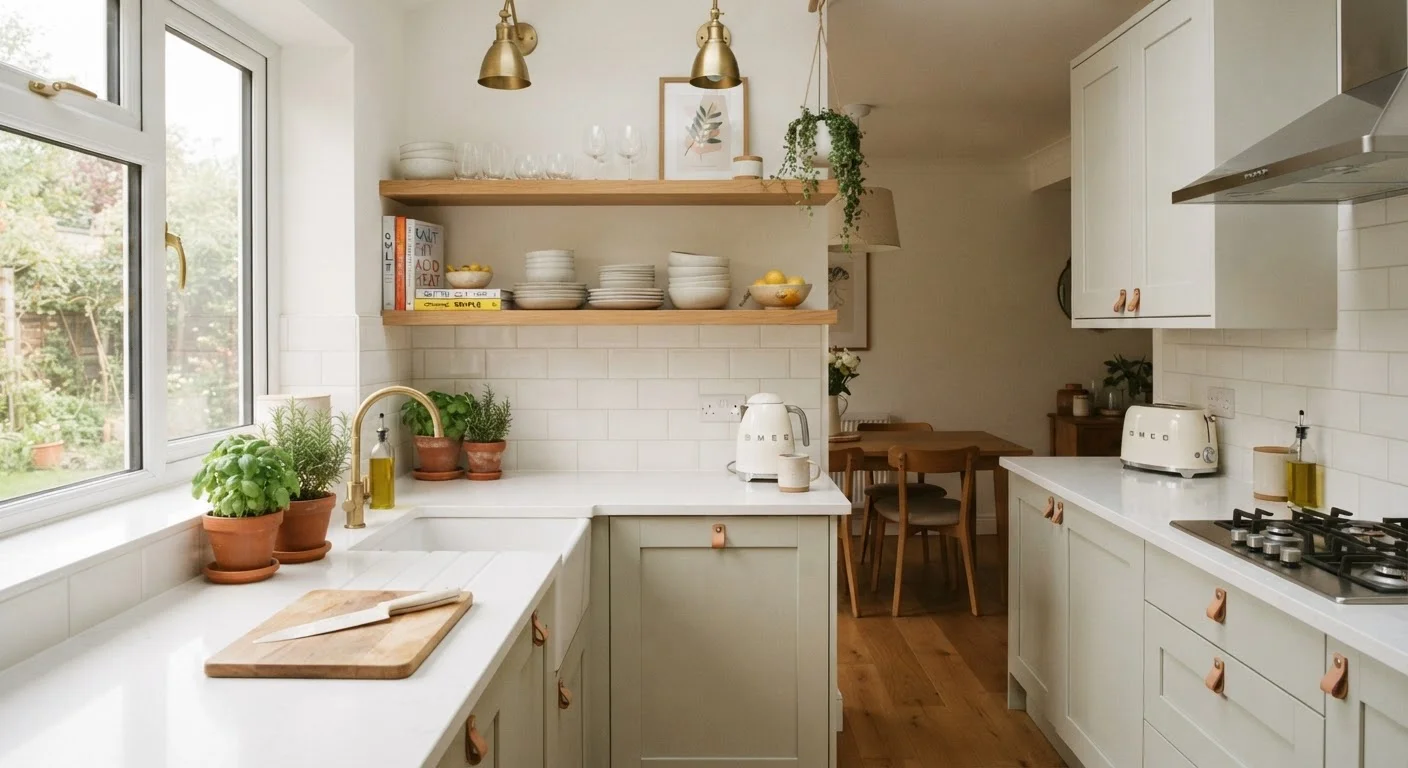
Treating open shelves as extra storage rather than curated displays.
Why it happens: Open shelves seem like free storage space, so homeowners fill them with whatever needs a home - mismatched mugs, random containers, and overflow from cabinets.
Open Shelving Requires Constant Upkeep
Open shelves look clean and styled in photographs, but in daily kitchen life they collect grease, dust, and everyday disorder quickly. If you're not prepared to edit and clean them regularly, open shelving can become the biggest source of visual clutter in the room. Consider your household's habits honestly before committing to this look.
It's also worth examining whether any widely held design assumptions are shaping your choices in unhelpful ways. Several common decorating myths - like the idea that you must match all your metals, or that open shelves always look better than cabinets - may be working against you without your realizing it.
Building a Calmer Kitchen Over Time
Correcting a cluttered kitchen rarely requires starting over. In most cases, the improvements are subtractive: removing items, consolidating finishes, and redirecting objects off surfaces and onto walls or into cabinets. The goal is a space where the eye knows where to land and where function and appearance support each other.
62%
Homeowners who feel their kitchen is disorganized
According to a survey by the National Association of Home Builders, the kitchen ranks among the top rooms homeowners want to improve for organization and function.
3-5
Decorative focal points recommended per room
Interior design educators broadly advise limiting strong visual anchors to a small number to maintain a sense of calm and intentional design.
If the broader principles of room cohesion are new territory, exploring general home décor guidance can build the foundational knowledge that makes individual decisions easier. The kitchen is one room - the same thinking about balance, restraint, and visual hierarchy applies throughout the home.