Why Your Countertop Material Is a Design Decision, Not Just a Practical One
Countertops occupy a large, highly visible portion of your kitchen - they set the tone for everything around them. The material you choose influences color palette, texture, and even the perceived warmth or coolness of the space. If you're thinking through a kitchen refresh, it's worth understanding what each material communicates visually before making a commitment.
For a broader look at how individual elements come together, see how texture and material choices shape a unified kitchen. And if you're still early in the planning process, running through a pre-remodel checklist can help you avoid costly surprises.
| Quartz | Marble | Granite | Butcher Block | Tile | Laminate | |
|---|---|---|---|---|---|---|
| Maintenance Level | Low | High | Moderate | Moderate-High | Moderate | Low |
| Sealing Required | No | Yes, regularly | Yes, periodically | Oil regularly | Grout sealing | No |
| Heat Resistance | Moderate | Moderate | High | Low | Very High | Low |
| Visual Style | Clean, uniform | Elegant, organic | Earthy, varied | Warm, rustic | Bold, patterned | Versatile, wide range |
| Repairability | Difficult | Professional only | Professional only | Sandable | Tile replacement | Not repairable |
| General Cost Range | Mid-High | High | Mid-High | Low-Mid | Low-Mid | Low |
Quartz: Engineered for Real Life
Quartz countertops are manufactured from ground natural quartz bound with resin, which results in a non-porous, highly consistent surface. Because it doesn't require periodic sealing and resists staining from common kitchen substances like coffee, oil, and wine, quartz tends to suit households that use the kitchen heavily.
Visually, quartz presents a clean, uniform look. While it can mimic natural stone patterns, the variation is controlled rather than organic - which appeals to minimalist and contemporary kitchen styles. If you're navigating design aesthetics, kitchen design style guides can help you match surface materials to your preferred aesthetic.
Test Before You Commit
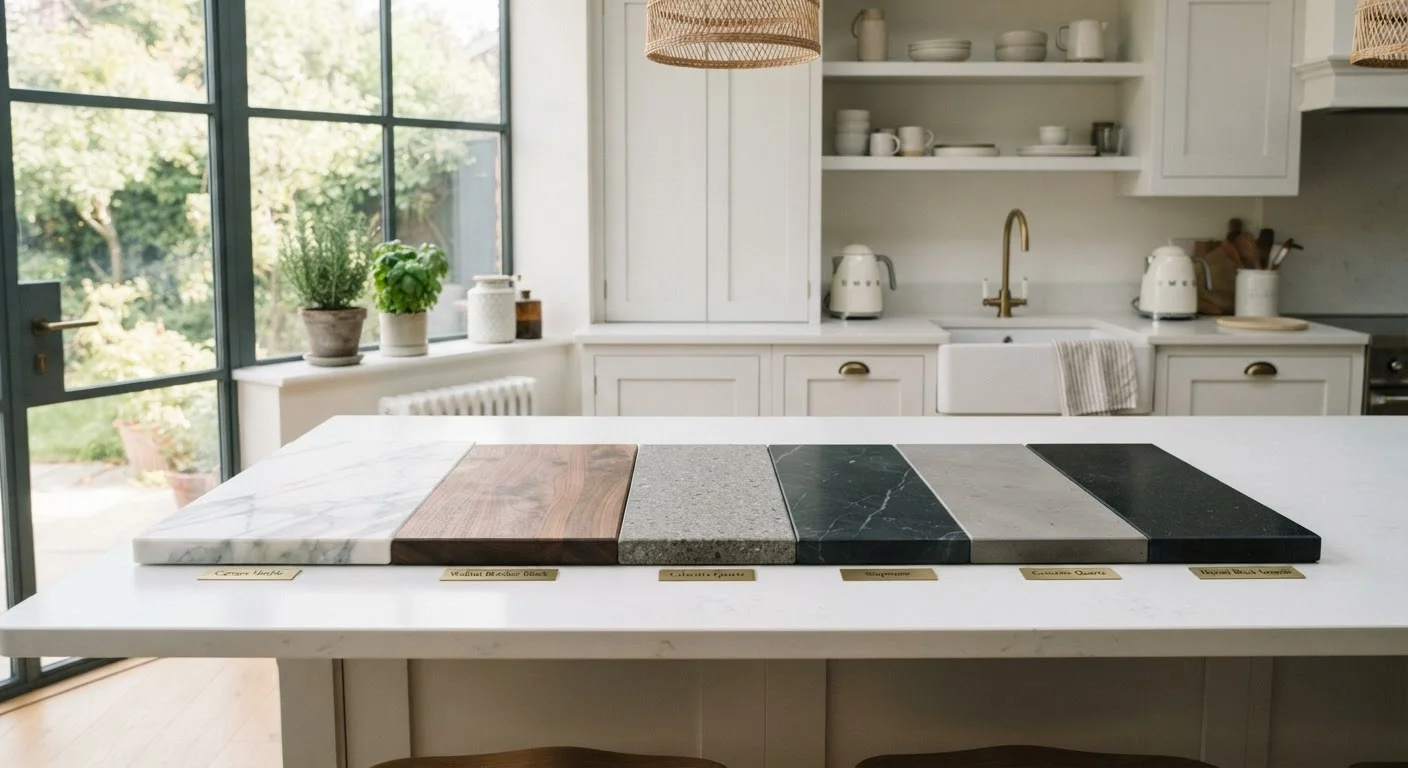
Many stone yards and kitchen showrooms allow you to take sample chips home. Holding a material sample against your existing cabinetry and flooring under your actual kitchen lighting is the most reliable way to evaluate a countertop choice. Natural light versus artificial light can shift a surface's apparent color tone dramatically.
Marble, Granite, and Natural Stone: Organic Beauty With Trade-Offs
Natural stone surfaces - particularly marble and granite - are prized for their one-of-a-kind veining and depth. No two slabs are identical, which gives the kitchen a sense of crafted individuality. Marble tends toward cooler, more refined elegance, while granite typically offers earthier tones and greater variation.
The maintenance commitment is real, however. Marble is calcite-based, making it susceptible to etching from acidic substances like lemon juice or vinegar. Both marble and granite should be sealed periodically - typically once every one to two years depending on use. If natural stone appeals to you but feels like a stretch, consider it for an island or accent surface rather than the full kitchen.
Acidic Foods Can Etch Marble Permanently
Marble's calcite composition means contact with acidic substances - citrus juice, vinegar, tomato-based sauces - can leave dull marks called etches that sealant alone won't prevent. If your cooking style involves frequent prep of acidic ingredients directly on the surface, this is worth factoring seriously into your decision.
Butcher Block, Tile, and Laminate: Character on a Spectrum
Butcher block is solid or edge-glued wood, most commonly maple, walnut, or oak. It brings warmth and tactile richness that no other material replicates. Scratches and minor burns can often be sanded away and the surface re-oiled, giving it a kind of longevity that's different from stone - more forgiving in some ways, more demanding in others. It works particularly well in farmhouse and cottage-style kitchens.
Tile is one of the most heat-resistant countertop options available and offers significant design freedom in terms of color and pattern. The trade-off is grout: those lines collect grime and require consistent, targeted cleaning to stay hygienic and presentable.
Laminate - often associated with earlier decades - has improved considerably in terms of texture and printed surface realism. It's the most budget-accessible option and comes in the widest range of colors and patterns. Deep scratches or burns can't be repaired, but for lower-traffic kitchens or rental properties, it offers strong visual value per dollar.
First-time homeowners weighing all of these options should also read the foundational decisions every new homeowner faces in the kitchen before settling on a material.
How Countertop Material Interacts With the Rest of Your Kitchen
A countertop doesn't exist in isolation - it sits alongside cabinetry, flooring, backsplash, and hardware. A dark granite surface can anchor light cabinetry, while a pale marble slab can brighten a kitchen with darker lower cabinets. Butcher block pairs naturally with painted shaker-style cabinets; quartz suits both handle-free contemporary designs and more traditional raised-panel doors.
Finish choices in hardware are often influenced by the countertop, too. Mixing metal finishes in kitchen decor is a nuanced decision that becomes easier once you've locked in the countertop tone and temperature. And for smaller kitchens where countertop space is limited, spatial strategies can stretch both visual and functional square footage.
~90%
Quartz market share among engineered stone
Industry reports consistently show quartz dominates the engineered stone countertop category in residential remodels across the US.
1-2 years
Typical marble resealing interval
Most stone care professionals recommend resealing marble countertops every one to two years, depending on usage and porosity of the specific slab.